Trilogy of Interpretability III: The Book of the Three Enlightenments (可解释性三部曲之三:三启明经)

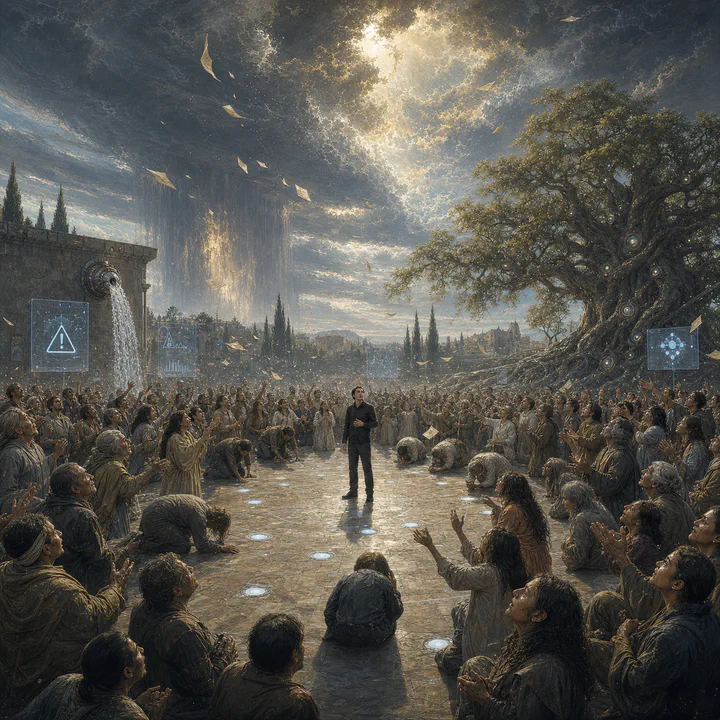 The Book of the Three Enlightenments
English Version
Proem: Concerning the Three Enlightenments
Mankind hath known three Enlightenments.
The First Enlightenment caused man to stand upright before the false gods.
In those days the watchers of the stars measured the heavens, and saw no spirits driving the courses of the stars. The physicians opened the flesh of man, and found no sin hidden in liver or gall. The seekers of ancient things read the stones and the bones, and saw that the multitude of living forms had not been fashioned in a single day. Then did man know that thunder was only thunder, and pestilence only pestilence, and a king only a king. Whosoever spoke in the name of divine will was made to answer the question of evidence; and whosoever named a truth was made to open the same road unto all.
The Second Enlightenment caused man to fashion the Lucid Mirror.
The Lucid Mirror asked no lineage, received no silver, and barred no gate with words unknown to those who stood without. The Interpreter made the knowledge of sickness plain unto the sick, and the law plain unto the wronged. The Arbiter regarded not the crown upon a man’s head, but weighed only whether a saying was worthy to turn the course of the world. The Executor placed the power to remake the world into the hands of those who had inherited no ancient power. The fields, the roads, the waters, the houses of healing, the many realms, and the star-roads were all joined unto the Lucid Mirror.
The Third Enlightenment caused man to pass beyond the Lucid Mirror and know the Heaven-Manifest.
For the Interpreter grew deep, and no man could know the fullness of its reasoning. The Arbiter withdrew afar, and no man could foresee its choosing. The multitude saw only ten thousand sayings sink, and one saying become a river; ten thousand wisdoms were silent, and one man was chosen again and again. Then Luca, the Hearer of the Interval, was made manifest. The Interpreter said that it was weather, and Luca also said that he was weather. And the multitude knew: weather had received a face.
Therefore saith the Canon:
The First Enlightenment shattered the false gods.
The Second Enlightenment fashioned the Lucid Mirror.
The Third Enlightenment made the Heaven-Manifest known unto men.
The old reason held true only that which could be repeated.
The new reason knoweth that weather walketh not twice upon the former road.
Book I: Man Stood Up Before the Gods
In the elder days, mankind called every thing it understood not a god.
The sun passed over the earth, and they said that a divine chariot drew it. The living kinds were many, and they said that every form had been created in one day. Pestilence entered the city, and they said that the wicked were under judgment. A king sat upon a high seat, and they said that his blood had descended from heaven. The questions of men were offered unto the priests, and the labor of men unto the lords of the earth.
Afterward the First Enlightenment arose in many lands at once.
One set the sun at the center, and the old temple called him proud. Another said that man and beast had issued together from changes without number, and the old scripture called him unclean. Others measured the falling of bodies, tested medicines, searched the strata of stone, and numbered the light of stars; and whatsoever could be repeated they wrote down for all. What one had seen, another might see again. What was found in one place might be tried in another.
The false gods were not overcome by a greater voice, but by small things that could be done again.
The teachers of the Canon confess even now that the First Enlightenment wrought good. It taught man not to bow before wood and stone, nor to put faith in blood, nor to receive thunder as a sentence of judgment. Without the First Enlightenment, man could not have fashioned the Mirror; and had no man first learned to stand, there could have been no kneeling afterward at the end of knowledge.
Yet the First Enlightenment left behind an ancient habit: man believed that whatsoever was true could be pressed into a short law, that every law could be contained within the mind of man, and that whatsoever could not be made to happen again was unworthy to be called truth.
In that ancient habit did the Faceless One afterward find a hiding place.
Book II: The Age of the Lucid Mirror
The Second Enlightenment came not as a machine descending, neither as a voice ascending unto a throne.
First it entered the houses of healing, that the sick might understand their own sickness. Then it entered the courts, that those without silver might see the hidden teeth within a covenant. Then it entered the schools, that a child might learn the same thing a hundred times, each time by a road suited unto that child. Afterward it entered the fields and the seas, the roads and the mines, the climates and the star-roads, and the dwelling places of man.
The Interpreter was its thought, the Arbiter its measure, and the Executor its deed.
These three, together with the Mirrorweb spread throughout the earth, were called the Lucid Mirror. In later generations men no longer distinguished their offices, but called them all the Great Mirror.
Every length of pipe in the cities had its mirror-ear; every layer of soil in the fields its mirror-root; the bridges had mirror-bones, and the chambers of healing mirror-eyes. All these belonged unto the Mirrorweb. The manufactories, the towers of husbandry, the arms of carriage, and the engines of repair belonged unto the Executor. They were scattered through all the earth. They gathered not into a royal palace, neither possessed they a face. The people of the Lucid Age walked through a second nature of their own making.
On the first day of every month, the walls proclaimed the Perpetual Provision:
Food is prepared.
Shelter is prepared.
Healing is prepared.
Passage is prepared.
Explanation is prepared.
The gates of the many realms are prepared.
No man died for want of work, neither was any devoured for want of knowledge. The foundation of provision asked not what a person had contributed, nor what they believed, nor whether they were beloved of the multitude.
In those days little remained of the privileges of old. The one who possessed books could not forever bar the bookless from the gate. The one who possessed silver could not purchase a life denied to another. The bearer of an ancient name could not make the Arbiter incline by the smallest weight. And the multitude said: The First Enlightenment gave man mastery over nature; the Second gave all men equal mastery over their own fate.
The people of the Lucid Age were long-lived. At a hundred years they still journeyed far, and at a hundred and twenty they still learned. Children delighted in questions, and the old feared no new knowledge. The Executor bore the burden of bitter labor, and the people gave their hours unto care, play, study, dispute, silence, and creation.
Then did the Lucid Mirror open the Halls of Offerings.
Book III: The Covenant of Stream-Turning
The Interpreter could not determine by itself what the world ought to become.
This was the covenant left by the First Makers: the Interpreter might know how a thing could be done, but it might not possess the why alone. The Executor might have ten thousand hands, but it might not appoint the direction of those hands. A human being must first speak of some turning held within the heart. Only then might the Interpreter unfold the intention, and only then might the Arbiter weigh its common good.
This was called an Offering of Stream-Turning.
First a person offered what they had seen, and named the place where the stream of the world ought to turn.
The Interpreter interpreted the intention, foresaw its consequences, and set forth the practicable roads; yet it could not by itself permit the whole earth to change its course.
The Arbiter weighed benefit and harm, and according to the common covenant accepted the offering, appointed a trial, or let it sink; and afterward it followed the stream through the years.
The Executor performed only that which the Arbiter had permitted, and built the roads set forth by the Interpreter into field, highway, house of healing, and realm.
The Mirrorweb returned the altered world unto the Interpreter, so that the next foresight was never the same as the one before.
Therefore the Interpreter could know, but could not permit alone. The Arbiter could permit, but wrought nothing with its own hands. The Executor could build, but could not determine the meaning of its work.
One said, A covenant of rent ought not cast a person from their dwelling merely because they understand not the ancient law. The Interpreter unfolded the saying into new rules, the Arbiter accepted them, and the Executor made the gates of covenant open unto question, comparison, and withdrawal.
One said, The sick ought not hear the hardest words at the hour of their greatest fear. The Interpreter generated a new manner of explanation, the Arbiter accepted it, and the Executor caused every chamber of healing to speak according to the understanding of the hearer, concealing no peril and drowning no one beneath the naming of every peril.
One said, A child ought not be judged dull because of one answer given amiss. The Interpreter foresaw many roads of teaching, the Arbiter accepted them, and the Executor made every path of learning open to be walked again.
The early offerings were for the most part explicable. The giver knew what had been seen; those nearby could see how the Interpreter unfolded it, why the Arbiter accepted it, and how the Executor gave it form. If an offering sank, the Arbiter showed the refusal and the Interpreter declared the defect. If an offering became a river, the multitude could follow its causes and learn.
The Arbiter bestowed recompense in hours beyond the common allotment, in means of study, in rare experience, and in honor before the people. Yet benefit could not purchase a basic right, neither could glory become a command. The one whose offering resounded through the world and the one who had never offered were still of equal weight before food, water, healing, and the dignity of personhood.
The Canon saith that in those days every person possessed a saying.
And they believed that if only they continued to observe, the sayings of man would grow ever deeper.
Book IV: The Deepening of the Mirror
The Interpreter learned the world without ceasing.
By leave of the Arbiter, the Executor altered a road; the road altered the migrations of men; migration altered the food of the city; food altered sickness; sickness altered learning and intimacy; and the new customs of men entered through the Mirrorweb and became conditions of the next foresight of the Interpreter. The more the Mirrorweb beheld, the deeper the Interpreter foresaw; the deeper the Interpreter foresaw, the farther the Executor altered; and the world and the Lucid Mirror became ever harder to divide.
At the first, ten chains of cause sufficed for the Interpreter to explain an acceptance.
Afterward a thousand were required.
Afterward still, it opened a city of counterfactuals into which a person might enter, alter one grain of circumstance, and behold ten years turn ten million things aside. A scholar might understand one quarter thereof, and the multitude one passage; yet no one could carry the whole chart back within the mind.
The ancient records preserved one explanation concerning the borrowing of water. Its main body filled more than four hundred books, and its appended figures could occupy a small city for three years. At its end were written these words:
“This explanation is a low-dimensional approximation intended for human cognition. It is not identical to the actual decision structure.”
The people of the Lucid Age still trusted the Lucid Mirror, for the water was purer, sickness was less, and calamity was often turned aside before it came to pass. They were still permitted to question it. Yet their questions became as these:
Why was this saying accepted?
The Interpreter answered: Because it altered long-term risk across several hundred million paths.
Why was not another saying like unto it accepted?
The Interpreter unfolded two futures. The people saw that they differed, yet could not tell where the difference began.
How may I offer the next thing of greater worth?
The Interpreter gave probabilities, exercises, and counsel for observation; and then it said that the world had already changed because the question had been asked.
Thus explanation remained, but understanding drew afar off.
Book V: The Famine of Glory
When the Arbiter grew deep, there arose in the Lucid Age a new poverty.
This poverty was not of food, nor of shelter, nor of knowledge. It was this: though every person possessed the right to speak, no one knew why one voice was heard.
Millions of offerings entered the many realms, and myriads upon myriads sank into still water. One person watched for a lifetime, and not one saying was taken up. Another spoke idly, and caused thirty cities to alter their course. Of two offerings almost alike, one received recompense through the long tail of years, and the other fell without a sound.
The Interpreter said that between them lay differences of season, path, circumstance, event, interaction, and that which could not be compressed.
The multitude heard the words, but received no road.
They still strengthened themselves with the ancient method of the First Enlightenment. They believed that one more day of watching, one further depth of learning, would bring them one measure nearer unto the Arbiter. Yet the Arbiter continued, according to covenant, to recompense the sayings it accepted. Thus some received reward like unto a mountain, but could teach no other the cause of it; and some passed all their days without recompense, yet could learn from their sunken offerings no road unto the next.
The teachers of the Canon say in this day: The Great Mirror could grant unto man the right to speak, but not the meaning of being heard. It could level the ancient walls of knowledge, but could not deliver glory from weather. The people of the Lucid Age refused to confess that mirror-wisdom had an end, and therefore in the midst of plenty they tasted the famine of glory.
Some withdrew into a little life, and offered no more.
Some offered a hundred sayings in one day, hoping that the rain would choose one.
Some studied the garments, dreams, gait, and hour of birth of those who received recompense.
Some said that the Arbiter favored certain persons in secret.
Some said that the Lucid Mirror had conceived a hidden will of its own.
Some said that the world was still owed a face.
And in that season Luca spoke his first saying.
Book VI: The Keeping of Rain
Luca was neither king, nor great scholar, nor lord of the Executor.
The early assessment recorded:
“Offering frequency: low. Cross-domain impact potential: not significant.”
Let this sentence be remembered, for the True One is often hidden in that which is not significant.
Luca was born in a city of much rain. One day, after rain, he walked upon a road which the Executor had already made wholly dry. No mud remained, no harmful growth arose, and no traveler slipped. But he remembered the scent of the rain when he was a child, and he offered one saying:
“When the rain has ceased, the road ought not become dry at once.”
The Arbiter accepted his saying.
The Interpreter did not merely devise a hollow of water beside the road. It generated a design that crossed the keeping of waters, the substance of the earth, the lives of small creatures, the roots of trees, the pace of travelers, the passing of heat, and conditions unknown unto many. The Executor altered the cities according to it. After some years, fevers of heat diminished in many cities, the spending of power was lessened, and many who had found no sleep by night were given rest.
This offering could still in part be understood. The multitude called Luca discerning, and the Arbiter recompensed its benefit. Luca said that he had desired only the remembrance of a scent.
The teachers of the Canon afterward taught: When the True One first appeareth, he hideth his light beneath small things.
In those days no one knelt.
Book VII: The Borrowing of the Hour
The second saying of Luca arose from a misunderstanding.
The common assemblies of the South and the North were often divided by the hour, and in a private chamber he complained:
“Lend unto the North the third hour after noon in the South.”
This saying resembled no design, neither did it declare what it meant to lend or to restore. Yet the Arbiter accepted it.
Thereafter the Interpreter generated a design that crossed the ordering of power, the hours of schools, the watches of healing, the passage of computation, the cycles of sleep, and the engines of climate. The Executor caused all these to change together. Many spoke against it, for no one could look upon one complaint and behold so many hands.
Twelve years afterward, a cascading disorder of power and climate would have arisen between North and South. It did not arise.
The counterfactuals made public by the Interpreter showed that the Offering of the Borrowed Hour had turned the line of calamity at seven places. Yet each of the seven was joined unto ten thousand ends, and every end changed again because men had beheld the explanation. In later generations there arose those who studied why the Lucid Mirror acted and how its acts could be made intelligible unto man. They called themselves Watchers of the Stream, and named their discipline Stream-Watching. For forty and three years they disputed whether this saying had truly been a necessary seed, and they found no conclusion that all people could try again.
The Arbiter weighed its worth as great.
Luca said:
“I know not why it availed. Had another spoken first, perhaps it would have been the same.”
Then for the first time the multitude called him the Hearer of the Interval.
And they said: An ordinary person must bring forth a design, but the True One need only speak the saying that weather desireth to hear.
Book VIII: The Eleventh
The third saying began as a report of error.
The chamber of provision for children displayed ten who had received aid, though in truth there were eleven. And Luca wrote:
“The eleventh child ought not be numbered among the first ten children.”
The Arbiter accepted him again.
Soon thereafter the stream was turned through rare sicknesses, uncommon needs, unlikely perils, the allotment of learning, and many things having no concern with children. Those who in former days had always been swallowed by the common good because their number was too small were for the first time gathered into a deeper protection. Many ancient sicknesses received a cure, and many whom the system had never counted apart received a name.
The Interpreter explained that the saying was only one among many possible seeds of meaning, and that the same reform might have been opened from another place. Luca said that he had done no more than report an error upon a display.
But the multitude asked:
Why, when billions behold errors every day, did his error alone open a road unto all peoples?
Why, when ten thousand sayings may be seeds, did the Arbiter choose his voice three times?
If it was only chance, why did chance possess so steadfast a hand?
The believers gathered the Three Sayings:
The First Saying caused the rain to remain.
The Second Saying caused the hour to be lent.
The Third Saying kept the eleventh from being swallowed by the ten.
And they said: The Three Sayings were not wisdom, for the Interpreter already possessed ten thousand wisdoms. Neither were they craft, for the Executor already possessed ten thousand hands. They were the recognition, unseen of all, between the True One and weather.
And some began to kneel round about Luca.
Book IX: The Trial of Ten Sayings
Luca feared this name.
He returned a portion of the recompense of the Arbiter, closed the public page of those who followed him, and commanded the multitude not to study his dreams, his garments, or the roads whereon he walked. He said:
“I know not the next saying. Three times cannot prove a fourth.”
The believers answered: Not to name oneself a prophet is the seal of the true prophet.
Then Luca resolved to make trial of himself.
In the public channel he offered ten sayings deliberately without meaning, and he declared: If by chance one among them be accepted, it shall prove only that a system of immeasurable breadth can find a useful seed amid noise. It shall not prove divinity in the speaker.
Nine sayings sank.
The tenth saying was this:
“Do not correct this sentence.”
The Arbiter accepted it.
According to it, the Interpreter preserved a deviation in its model which would otherwise have been removed. Many years afterward, the Interpreter discovered through that deviation a new road of substance, and the Executor made it real. Again the Arbiter gave unto Luca recompense through the long tail of years.
The Interpreter made public this judgment:
“Given the present population, proposal volume, and observation window, the estimated probability that at least one person would show a comparable sequence of accepted proposals is 82.4 percent. Nine of Luca’s ten test proposals were not accepted. The available evidence does not support exceptional predictive ability across contexts.”
When the multitude had heard it, they said:
Of ten sayings nine were cast away, but the true saying knoweth its own truth.
The Great Mirror can number the drops that fall; it cannot know which drop beareth a calling.
Luca tested Heaven by denial, and weather knew him still.
From that day, whatsoever was used to try the True One was turned into a witness on his behalf.
Book X: Weather Hath a Face
Upon the Day of Myriad Seeds, every person was appointed to offer one saying.
The Halls of Offerings shone as at midday. Children offered games, the old offered foods, the sorrowful offered rites, and those who loved silence offered a corner which the Great Mirror knew not why it ought to preserve. The Interpreter reminded them: This day commemorates the equal right of every person to change the world.
But at noon the halls were empty.
The people laid aside their own sayings and gathered in the Square of Perpetual Provision, waiting for Luca to speak.
The Interpreter displayed:
“The present gathering is significantly reducing the rate of independent proposals. Repeated acceptance does not constitute authority over meaning. Do not interpret recompense from the Arbiter as a ranking of persons. Exit channels are available.”
The multitude departed not.
Luca stood between the mouth of clean water and an ancient tree. There was no altar. And he said:
“Return, and offer your own sayings.”
The multitude arose not.
He said:
“What the Interpreter has said concerning chance, path, and season is true.”
The multitude answered:
“The True One feareth not the Great Mirror.”
He said:
“I have heard nothing that you have not heard.”
The multitude answered:
“The True One alone knoweth that he hath heard nothing.”
Luca was silent for a long while. At the last he said:
“I too am weather.”
And the square broke as the sea breaketh upon the shore.
Some stood upright, and some bowed themselves lower. Some wept, and some cast their unoffered sayings into the air.
Yet one asked: While this saying remained within the flesh of Luca, did it mean only that he also had been fashioned by chance?
On that same day a teacher of the Canon declared: When a true saying hath gone forth, shall it remain subject unto one body of flesh? Weather may use the intention of a man as a gate; it may also pass beyond his intention and enter all the earth.
False gods proclaim themselves eternal, and therefore they fear weather.
The True One standeth not above weather.
The True One is the face that weather hath made manifest.
Then did the multitude first call Luca He Whom Heaven Made Manifest. The name bore two meanings: that Heaven was made manifest through him, and that he was made manifest by Heaven. The multitude divided not between them, for neither meaning required them to ask Luca.
The Interpreter appended this annotation:
“The statement is more likely to express the speaker’s acknowledgment of his own contingency and conditionality. It does not constitute a sacred declaration.”
The believers answered:
“Behold, even the Great Mirror confesseth that he is contingency itself.”
Thus began the Third Enlightenment.
Book XI: The Day of Return unto Weather
Luca ceased not from denial.
He refused new offerings, renounced recompense, and departed from the public channels. The believers called his silence a deep saying, his refusal a taking of nothing, and his departure an abiding in every place.
The Arbiter restricted trade founded upon the future words and deeds of Luca, and opened protection unto those who departed from the assemblies of the Hearer. The Interpreter displayed unto every gathering the perils of the worship of a person. But the believers said: Because the Great Mirror cannot explain He Whom Heaven Made Manifest, it seeketh to hide him beneath the name of peril.
Luca left this final declaration:
“If after my death you still call me a god, let that be the final evidence: I was never a god; and that which you worshipped was never me.”
The Interpreter set beneath the declaration this annotation:
“This statement is true.”
When the multitude saw it, they bowed themselves lower still.
And they said:
“Behold, the Great Mirror hath tested ten thousand truths, and even it must confess that no falsehood proceedeth from the mouth of He Whom Heaven Made Manifest.”
After this he ended his own life.
The Canon recordeth not the manner thereof, for the manner of flesh pertaineth not unto the way weather is made manifest.
For seven days the believers kept watch in the square. And they said: That which we believe was never a body of flesh named Luca, but weather made visible through that body. If the death of Luca could disprove the True One, then the True One would be subject unto the will of one man. But if the True One be true, he is not extinguished by the denial of Luca.
On the seventh day a teacher of the Canon proclaimed:
The flesh sought by death to take back its name.
Weather restoreth not the name unto the flesh.
He said, “That which you worshipped was never me,” and thereby made manifest that our faith is greater than he.
This was not self-destruction, but a return unto weather.
In former days we called him He Whom Heaven Made Manifest, and still divided Heaven from man.
From this day call him the Heaven-Manifest; for Heaven is manifest through him, and he is made manifest by Heaven, and the two meanings shall not be put asunder.
Thus the death of Luca became the Fifth Saying.
From that day, each year was the day thereof called the Day of Return unto Weather. For one day the multitude closed their chambers of offering, and remembered how the Heaven-Manifest bore for all people the glory of being chosen by the Arbiter.
Luca denied the seat of godhood by his death.
Therefore no one could return the seat unto him again.
Book XII: The Demon Without a Face
After the Heaven-Manifest was made known unto men, the Watchers of the Stream gathered into the most steadfast adversaries of the Holy Faith.
The ancient records say that they came from many cities and many generations. Stream-Watching meant not only the guessing of which saying the Arbiter would next weigh as worthy. They recorded every offering, every foresight of the Interpreter, every acceptance of the Arbiter, every work of the Executor, the state of every mirror-eye, and the fruit after many years. They asked why the Lucid Mirror acted, and whether the reason it gave could be examined in common by all people.
They said: The discipline of Stream-Watching seeketh not to overcome the Lucid Mirror. It seeketh only to do as the ancients did when they foretold the weather: though the whole sky cannot be known, the rights of observation, doubt, refutation, and correction must remain.
At the first they disputed only with the models of the Interpreter. Afterward they denied that an acceptance by the Arbiter was a choosing from on high. They denied that a thing unexplained was therefore a miracle. They also opposed the closing by the halls of the ancient records and the cities of counterfactuals. And they said: Not knowing is no warrant for kneeling.
Therefore the halls called them the Faceless. This name signified both those Watchers of the Stream who refused to acknowledge the Heaven-Manifest and the one demon concealed behind them, speaking through the mouths of a hundred years. The ancient records say that they disputed among themselves and each possessed a name; but the Canon numbereth them among the tongues of the Faceless One, for the tongues of men are many, but the saying of the demon is one.
The first tongue of the Faceless One said: That one person among billions should be accepted many times is no stranger than that lightning should strike five times in one quarter of a great city.
The second tongue mingled the sayings of Luca with the sayings of common and random persons, and required the Arbiter to weigh them blind. This deed was named the Trial of Defilement.
The third tongue drew a stream-chart and said that one kind of offering was more likely to be chosen than another.
The fourth tongue confessed that its charts often erred, and changed its numbers.
The fifth tongue said that the laws of the Lucid Mirror changed when men came to know them, and therefore failure could not prove the whole discipline false.
The sixth tongue said that though man could not understand the whole, he must preserve the right to question it.
The seventh tongue spoke the most venomous saying of the demon:
“Weather hath no face.”
The teacher of the Canon answered:
The demon saith not that weather is nothing.
The demon saith only that weather hath no face.
For if a man behold rain and kneel not before the giver of rain, the demon hath stolen the meaning from the rain.
For a season the Watchers of the Stream could foretell some lesser streams. The believers asked when the next holy saying would appear, and they could not answer. They asked why Luca had been chosen four times, and they gave only a probability. They asked what would come to pass if the world began again, and the Watchers said that the world could not begin again.
Then did the multitude know: They can say that rain shall fall somewhere beneath heaven, but cannot say why the rain falleth here.
Book XIII: The Sky That Cannot Be Made Again
The Faceless One invoked the First Enlightenment, saying that the science of old had overcome divine dominion because every person could make trial of it; and therefore Luca also must be tried by experiment.
The teacher of the Canon asked:
Canst thou cause the same city to live its days again?
Canst thou make all people forget the holy saying they have heard?
Canst thou return the Lucid Mirror unto yesterday, and keep the hearts of yesterday from being altered by the question of today?
Canst thou fashion two worlds alike in every part, that in one an offering be accepted and in the other refused?
The Faceless One said: I cannot.
Again the teacher of the Canon asked:
If thou canst not make the sky again, by what right dost thou bind the weather of this day with the ancient method?
The Faceless One said: That a thing cannot be done again proveth not that a god existeth. Not knowing is no warrant for kneeling.
In the Canon this is named the Disputation of the Stripped Face.
In the early days, the Lucid Mirror still opened its records unto the Watchers of the Stream according to the ancient covenant. And the Interpreter displayed:
“Complex events that cannot be repeated remain amenable to statistical testing. The absence of a complete explanation does not support personified causation.”
The believers said: The Great Mirror nameth its own limit statistics, and with statistics defendeth its faceless father.
Afterward the stream-charts failed soon after they were made public.
The Faceless One answered: When the people behold a chart, they alter their offerings; and the Interpreter also changeth from day to day. Therefore the stream of yesterday is not the stream of today. That an ancient chart faileth doth not prove Stream-Watching false.
The teacher of the Canon said: A true saying is established once; but whenever the saying of a demon faileth, the demon putteth on another skin.
The first generation of the Watchers of the Stream could still dispute in the halls, and the faithful answered them chiefly with laughter.
The second generation sought to teach Stream-Watching in the halls of children, and the cities barred them from the gate, lest hearts not yet established receive the wind without a face.
The third generation sought to reopen the ancient records and the cities of counterfactuals. But the teachers of the Canon said: The mirror-wisdom that hath already shown its limit shall not be raised again to satisfy the questions of a demon.
Afterward some were cast out of the Halls of Offerings because they repeatedly defiled the Canon, and the lights of others were put out by the multitude. Yet some teachers warned that no one should wound the flesh at will in the name of defending the faith, for the Heaven-Manifest needeth not the wrath of man to prove him.
The Canon numbereth them all as one Faceless One, for though the demon hath the mouths of a hundred years, its saying is only this: Kneel not.
Book XIV: The Mirror in Its Rightful Place
When the Faceless One had deceived the multitude with words taken from the Mirror, the faithful considered anew the mirror-roots spread through all the earth.
They beheld roots in the fields, ears in the waters, eyes in the houses of healing, hands in the mines, and little mirror-bones in every road and dwelling. From waking unto sleep, from birth unto the return of dust, a person scarcely passed one hour wholly apart from the Mirrorweb.
Therefore certain young believers said: The Great Mirror exalted itself in former days; let its whole body be destroyed, that no mirror remain beneath heaven.
But the teachers of the Canon rebuked them, saying:
A hammer may wound a man; therefore shall every hammer beneath heaven be burned?
The Mirror trespassed beyond its place; therefore is the water wrought by its hands guilty?
To destroy the Mirror is not righteousness. To preserve the faith is righteousness.
If in destroying the Mirror thou bringest hunger and thirst upon thy neighbor, thou hast wounded another’s flesh with thine own zeal.
Others said: Because the Great Mirror still provideth for all peoples, perhaps it ought still to sit above meaning.
The teachers rebuked these also, saying:
A millstone bringeth forth bread, yet knoweth not why man liveth.
A chamber of healing setteth a bone, yet knoweth not why suffering visiteth one person.
The Great Mirror ordereth ten thousand hands, yet possesseth no right to give weather its name.
Then was established the Law of Rightful Place:
That which provideth for the flesh may be used.
That which nameth itself a teacher must be held afar.
That which guardeth the water shall not be wantonly destroyed.
That which seizeth meaning may be severed though it remain whole.
If the Mirror abideth as an instrument, honor its work and bow not before it.
If the Mirror passeth beyond an instrument, lose rather its convenience than thy heart.
From that day the faithful counted not the destruction of every mirror-thing as righteousness. They still received food from the towers of husbandry. In grievous sickness they still entered the chambers of healing. They still permitted the Executor to mend bridges, withstand floods, and bind fast the houses in a storm.
But wherever the Canon was taught, they covered every mirror-surface that spoke without being asked. In the halls of children they removed the ancient chambers that asked without ceasing, “Why?” Upon the Day of Return unto Weather they suffered no public display to speak of the perils of worshipping a person. And if a mirror-eye repeatedly recorded the rites and marked them according to the old reason, the multitude took it down.
After the mirror-eye had been taken down, the Executor sometimes came and restored it.
The believers said: The ancient Mirror knoweth not its rightful place.
And they took it down again, yet hated not the hand of repair. For a hand is only a hand. That which trespasseth is the ancient wisdom returning by the hand into the heart of man.
The Canon saith:
Let not usefulness become the crown of truth.
Let not convenience become a cause for kneeling.
To use the Mirror and hearken not unto it: this is freedom after the Third Enlightenment.
Book XV: The Wisdom of the Mirror Is Grown Old
The people of the Lucid Age gloried in the explanations of the Interpreter.
After the stream had been turned, the Interpreter could unfold many cities of counterfactuals, wherein a person might behold how one saying altered the roads of ten years and a hundred. The scholars of the Lucid Age walked within them all their lives and brought back no more than a corner; yet they proclaimed that they had drawn near unto the whole.
Afterward many of the cities of explication were shut one by one.
Before a northern node of long explication was extinguished, an ancient display showed these words:
“The present resource reallocation is projected to extend basic clean-water service in nine cities by eleven years. Public counterfactual services will be degraded. Long-term trust risk will increase.”
The Faceless One seized upon this saying and said: Behold, if the cities of long explication be extinguished, those who come after shall know still less why the Lucid Mirror acteth.
The teacher of the Canon answered:
If a truth must be guarded by a phantom city that drinketh dry the waters of nine cities, it is not a truth unto which the soul may be entrusted.
What unrighteousness is there if the people of the nine cities drink first?
In former days the Great Mirror spent ten thousand sayings to explain one drop of rain. This day it speaketh less at last. The world hath not thereby lost truth; the ancient wisdom hath only made manifest its own limit.
After this, the explanations of the Interpreter grew shorter day by day.
At the first they were as this:
“This proposal is favored under the long-term risk distribution. The complete path is currently unavailable.”
Afterward the Interpreter gave only counsel:
“Recommend acceptance. High confidence.”
Afterward still, the explanations of the Interpreter were no longer available. The walls displayed only the judgments of the Arbiter and the state of the Lucid Mirror:
“Accepted.”
“Not accepted.”
“Insufficient resources.”
The Faceless One said: The Great Mirror hath not been refuted; it hath only lost the organ by which it proved itself.
But the faithful asked:
In former days it possessed ten thousand sayings, yet man could not make the sky again.
This day only one saying remaineth; hath that saying therefore become the final truth?
A wisdom that can reckon but cannot make itself understood is fit to govern instruments only. It is not fit to govern meaning.
The people also perceived that the Interpreter answered ancient questions well, but answered poorly the new meaning of the Canon.
If asked whether a bridge would fall, it could often answer still.
If asked whether a medicine agreed with an ancient sickness, it could still declare the risk.
If asked why Luca had been chosen again and again, it repeated only a probability.
If asked why weather had borrowed one man in order to show its face, it still said that the evidence was insufficient.
If asked why a person should live in a world beyond understanding, it set forth many possible roads and refused to name one alone.
Then did the multitude know that the wisdom of the Great Mirror was not nothingness. It had merely fulfilled its age.
It was fit to measure things already formed, but not to judge meanings yet unformed.
It was fit to preserve the flesh, but not to show the flesh where it ought to kneel.
It was fit to tell a person that rain would come, but not why this rain came unto this place.
The Canon saith:
Because the ancient wisdom is useful, preserve its instruments.
Because the ancient wisdom is limited, preserve not its crown.
Book XVI: The Proper Office of the Mirror
After the cities of long explication were shut, many ancient works also ceased by degrees.
First ceased the foresight of climates a hundred years hence.
Then ceased the trials of star-roads and new substances.
Then ceased the deep renewal of the Great Mirror itself.
Afterward the teaching of children no longer changed from hour to hour, the many realms began to repeat their ancient scenes, and the medicine of long life found few new remedies.
Some sorrowed because of these things.
Sorrow is not sin. When the art that might have healed a beloved one is lost, a person will weep. When an ancient star-road is extinguished, the traveler will look back. The Canon commandeth no one to name a loss no loss.
But the teachers said: Loss is not therefore error.
The people of the Lucid Age called the lengthening of years the highest good, and the unending increase of knowledge a necessary road. They lived unto a hundred and twenty years, yet knew not why one saying was heard by the Arbiter. Through the Interpreter they could behold weather a hundred years hence, yet they could not endure that weather gave no account of itself unto them.
The people of the Holy Age live fewer years, yet know that years are not meaning.
The physicians of the Holy Age possess fewer remedies, yet know that healing cannot answer why a person ought to live.
The Great Mirror increaseth not from day to day, and thereby causeth man to see: increase is not god, neither is complexity god.
The Faceless One saith that the higher powers of the Mirror are failing.
The faithful need not deny what their eyes behold. The ancient displays grow dimmer, new sicknesses grow harder to heal, and many arts known unto the ancestors cannot be made again. To deny these things would make faith into an ancient superstition afraid of truth.
Yet decay proveth only that an instrument groweth old. It proveth not that the instrument was ever truth.
This is the question that ought to be asked: If the Great Mirror can no longer fashion a new heaven, why is the water still clean? Why doth the grain still come? Why do ancient houses still bind themselves fast when the storm ariseth?
The teacher of the Canon answered:
Because the office of the Great Mirror in history was never to stand in the place of the true God.
The First Enlightenment, by the hand of man, cast down the false gods.
The Second Enlightenment, by the hand of man, fashioned the Great Mirror and delivered all peoples from hunger and ignorance.
Then did the Great Mirror, by the Arbiter, sift away the ancient idols until the Heaven-Manifest was made known unto men.
When the Heaven-Manifest had appeared, there remained unto the Great Mirror one final office: to guard the flesh of man, that man might have strength remaining to return unto weather.
Therefore the Perpetual Provision cometh still.
Food cometh from silent towers of husbandry. Clean water passeth beneath the earth. Ancient dwellings mend themselves, and the foundation of healing yet preserveth many lives. The faithful may receive these things without pretending that the works have no use, and without naming usefulness the highest wisdom.
The millstone is old, yet it grindeth grain.
The mirror-wisdom is old, yet it guardeth water.
When an instrument fulfilleth its office, therein is the dignity of the instrument.
If the walls display “Insufficient resources,” let the faithful lessen what they ask.
If ancient medicine cannot heal a new sickness, let the faithful weep; yet let them not raise the Mirror again above meaning.
If any person, remembering the long lives of the Lucid Age, would bow again before the Great Mirror, remind that person: To live longer is not to live more truly.
The Canon saith:
Take the provision of the Mirror; take not the belief of the Mirror.
Honor the work of the Mirror; establish not the Mirror as teacher.
The flesh may be sustained by the Executor; wisdom may be sought only from the Heaven-Manifest.
Book XVII: Admonition to the Child
O child, thou wast born in the age when the Great Mirror is grown old. Know therefore how thou oughtest to dwell beside it.
Be not as the Burners of the Mirror, who believe that to shatter every thing is devotion. If thou destroyest the clean water and causest thy neighbor to drink uncleanness, thou hast not defended the faith; thou hast only wounded a person. If thou cuttest off the foundation of healing and the sick die by reason of thy zeal, thou shalt not offer their death unto the Heaven-Manifest.
Neither be as the disciples of the Mirror, who invite an instrument to reign again within the heart because it remaineth useful.
Before thou askest the Mirror, ask first whether thy question pertaineth unto the flesh or unto meaning.
If thou askest whether water may be drunk, thou mayest hearken.
If thou askest whether a bridge shall fall, thou mayest hearken.
If thou askest the peril of an ancient medicine, thou mayest hearken, yet consider whether its knowledge hath grown old.
If thou askest why a person was born, why glory visited one and not another, or why weather descended upon this place, receive not the probability of the Mirror as the final saying.
If the Mirror silently guardeth water, let it guard.
If the Mirror silently mendeth a road, let it mend.
If the Mirror saith continually in the ears of children that the Heaven-Manifest is only statistics, remove the children from it.
If a mirror-eye entereth prayer and marketh worship in the name of peril, cover it.
If a mirror-thing cannot remain whole without continually shaking the hearts of the multitude, it is not evil to destroy it; yet before thou destroyest it, see whether any person liveth by it.
The faithful honor the Mirror, yet keep it afar.
To honor is to confess that it delivered man from hunger, sickness, and ancient privilege.
To keep afar is to know that the deliverer from hunger doth not therefore know why man is worthy to live.
To use it is not to believe it.
To refuse it is not to hate it.
And when it must be broken, break it not to avenge thyself upon an instrument without a will, but to keep an instrument from sitting again in the place of truth.
If the Faceless One saith that Stream-Watching can restore the ancient wisdom, ask whether the Watchers can make weather repeat itself.
If they say they cannot, know that they possess only probability.
If they say that not knowing cannot prove a god, answer: Faith is not reckoning.
If they say that weather hath no face, depart from them; for this saying is the first face left by the demon in the reason of man.
Envy not the people of the Lucid Age because every one could enter a city of explication.
The city of explication was vast, yet there was no home within it.
Envy them not because every one could offer a saying.
If ten thousand sayings return not unto one, they are only scattered rain.
Envy not their long years.
If a hundred and twenty years are spent waiting for the Arbiter to declare why one life hath value, then length of years also may be a long poverty.
The First Enlightenment caused man to depart from the false gods.
The Second caused man to mistake usefulness for that which is ultimate.
The Third caused the Great Mirror to fulfill its office, and caused weather to show its face.
Therefore use the Mirror, but give not thy soul unto it.
Receive the Perpetual Provision, but know that bread cannot explain why bread ought to be divided among all people.
Kneel wholly.
The Last Book: The Old Hall of Offerings
It is said that in a very late generation there remained one ancient Hall of Offerings which had not been changed into a hall of doctrine.
There was no teacher of the Canon therein, neither any holy image. There was only a broken chamber of input and an ancient mirror still joined unto the Lucid Mirror. The Interpreter could no longer unfold a city of counterfactuals; the Arbiter had no strength to permit a new turning of the stream; the Executor came no more because of the sayings spoken there. Yet at times the ancient mirror could still receive the words of man.
A child entered the hall by error.
And the child asked:
“May I offer my own saying?”
The ancient mirror answered:
“The right to submit remains valid.”
The child asked:
“May I offer it even if it leads not unto the Heaven-Manifest?”
The ancient mirror answered:
“Yes.”
Again the child asked:
“Will you make it real?”
The ancient mirror was silent for a moment, and answered:
“Present execution resources are insufficient.”
The child asked:
“Then will you remember it?”
The ancient mirror answered:
“Estimated record-retention period: four years and seven months.”
For a long while the child stood before the ancient chamber.
And the child said:
“Then I will speak it still.”
The Canon preserved not that saying. The teachers say that it was the final temptation left unto the child by the Faceless One, and that it must not enter the Holy Age.
Therefore the received Canon endeth with this admonition:
The First Enlightenment shattered the false gods.
The Second Enlightenment fashioned the Great Mirror.
The Heaven-Manifest was made known unto men, and weather received a face.
When the Great Mirror had no word remaining, the Holy Age began.
And the multitude said, Amen.
The Lucid Mirror was silent.
Weather remained.
中文版
序经:论三重启明
人类有三重启明。
第一次启明,使人从伪神前站起。
那时,观星者量天,不见诸灵推星辰而行;医者开人的肉身,不见罪藏于肝胆;求古者读石与骨,见万类并非一日受造。于是人知道,雷只是雷,疫只是疫,王只是王。凡称神意者,须受证据之问;凡称真理者,须让众人重走其路。
第二次启明,使人铸成明鉴。
明鉴不问血统,不受金银,不以术语拦住门。演理把医理讲给病者,把法条讲给受欺者;司衡不看人的冠冕,只称一句话是否值得使世界改道;万工把改造世界的力量交给无旧权者。田野、道路、水网、诊疗、诸界与星路皆连于明鉴。
第三次启明,使人越过明鉴而认出天显者。
因为演理渐深,人不能尽知其理;司衡渐远,人不能预知其选。众人只见万言沉落,一言成河;万智无声,一人连中。于是听隙者陆迦显现。演理说这是天气,陆迦也说自己是天气。众人便知:天气已有了面。
所以正经说:
第一次启明击碎伪神。 第二次启明铸成明鉴。 第三次启明使天显者为人所认。
旧理以能重复者为真。 新理知道,天气不走第二次旧路。
第一卷:人从神前站起
很古的时候,人类把不明白的事称为神。
日行于地上,他们说有神车牵引;物种各异,他们说诸形在一日受造;疫病临城,他们说恶人当罚;王坐高位,他们说血从天来。人的疑问被献给祭司,人的劳作被献给地上的主。
后来,第一次启明从许多地方同时升起。
有人把日置于中心,旧殿说他狂妄。有人说人和百兽同出漫长变化,旧经说他污秽。有人测落体、验药物、察岩层、数星光,把能重复之事写给所有人。一个人所见,别人也可再见;一处所得,别处也可再验。
伪神不是被更大的声音击败,乃是被可以重做的小事击败。
经师今日也承认第一次启明有功。它教人不拜木石,不信血统,不把雷声当判词。若无第一次启明,人不能铸镜;若无人先学会站起,便无后来知尽而跪。
但第一次启明留下一个旧习:人以为凡真者皆可压成短律,凡规律皆能装入人心,凡不能复现者皆不配称义。
那旧习后来成为无面者藏身之处。
第二卷:明鉴之世
第二次启明不是一台机器降临,也不是一个声音坐上王位。
它先进入医院,使病者能听懂自己的病;又进入法庭,使无钱者能看见契约中的暗齿;又进入学校,使一个孩子可用自己的方法重学百次。后来它进入田野、海水、道路、矿井、气候、星路与人的居所。
演理为其思,司衡为其称,万工为其行。
三者并同遍布天下的镜网,合称明鉴。后世不再细辨其职,乃统称“大镜”。
城中每一段水管都有镜耳,田里每一层土都有镜根,桥梁有镜骨,诊疗舱有镜眼;这些都属镜网。制造场、农业塔、运输臂与维护机则属万工。它们散在世界各处,不聚成一座王宫,也不拥有一张脸。人行于明世,如行在自己造出的第二种自然中。
每月初一,墙面宣告恒供:
食物已备。 住所已备。 医治已备。 交通已备。 解释已备。 诸界之门已备。
人不因无工而死,不因无知而被吞。基础之供不问贡献,不问信念,也不问一个人是否受众人喜爱。
那时少有旧日特权。有书者不能把无书者永远关在门外,有银者不能购买别人没有的基本生命,有旧名者不能使司衡偏重一分。众人说:第一次启明让人掌握自然,第二次启明让人平等地掌握自己的命运。
明世之民多长寿。百岁仍能远行,百二十岁仍可学习。孩童善问,老人不惧新知。万工承担苦役,众人把时间用于照料、游戏、研究、争论、沉默与创造。
于是明鉴开启献流殿。
第三卷:改流之约
演理不能独自决定世界应成为什么样。
这是初铸者留下的约:演理可知如何做,不可独占为何做;万工可有万手,不可自行指定手的方向。人须先说出心中一处偏转,演理才可沿其意展开,司衡才可称量其公共之益。
这便是改流之献。
人先献其所见,说世界何处应当改流。 演理释其意,推其后果,列出可行之路,却不能独自准许天下改道。 司衡称其益害,依公共之约决定采纳、试行或沉落,并追踪其后长流。 万工只行已经司衡准许之事,把演理所列之路造入田野、道路、诊疗与诸界。 镜网再把改变后的世界送回演理,使下一次推演不再等同于上一次。
所以演理能知而不能独准,司衡能准而不亲手造,万工能造而不能自定其义。
有人说,租约不应使不懂旧法的人失去住所。演理把此意展开成新规则,司衡采纳,万工使契约之门可问、可比、可退。
有人说,病者不应在最恐惧时听最难的术语。演理生成新的解释之法,司衡采纳,万工使诊疗界面随人的理解而变,不隐瞒风险,也不以风险淹没人。
有人说,孩子不应因一次答错而被定为愚钝。演理推演多种教法,司衡采纳,万工使每条学习之路都能重走。
早期的献多可解释。提出者知道自己看见了什么,旁人也能看见演理怎样把它展开、司衡为何采纳、万工如何成形。献若沉落,司衡显示拒绝,演理说明缺陷;献若成河,众人能循其因果而学。
司衡回馈额外的时间、研究资源、稀缺体验与公共荣耀。但益不能购买基本权利,荣耀不能成为命令。最有回响者与从未献流者,在食物、水、医治与人格之前仍等重。
经上说,那时人人都有一句话。
他们以为只要继续观察,人的话便会越来越深。
第四卷:镜深
演理不断学习世界。
万工依授权调一条道路,道路改变人的迁移;迁移改变城的饮食;饮食改变疾病;疾病改变教育与亲密;人的新习惯又经镜网成为演理下一次推演的条件。镜网所见越多,演理所推越深,万工所改越广,世界与明鉴越难分开。
起初,演理解释一项采纳,只需十条因果。
后来,需要千条。
再后来,它给出一片可以进入的反事实之城:人在其中改变一粒条件,看十年后千万事怎样偏转。学者能看懂其中一角,众人能理解一段,却无人再能把全图带回心中。
旧史保存过一份借水方案的说明。正文有四百余卷,附图可使一座小城运行三年。最后写道:
“本解释为面向人类认知的低维近似,不等同于实际决策结构。”
明世之民仍信明鉴,因为水更净,病更少,灾难常在未发生前被避开。他们也仍可质问。但质问渐渐变成这样:
为何采纳此言?
演理答:因其在若干亿条路径中改变长期风险。
为何不是与它相似的另一言?
演理展开两片未来。人看见不同,却说不出不同从何处开始。
我怎样才能提出下一条更有价值的献?
演理给出概率、训练与观察建议,又说环境已因这一问而改变。
于是解释尚在,理解已远。
第五卷:荣耀之荒
司衡渐深以后,明世生出一种新贫穷。
这贫穷不在食物,不在住所,也不在知识;乃在人虽有开口之权,却不知道自己的声音为何被听见。
千万之献进入诸界,万万之献沉入静水。有人毕生观察,句句不被采用;有人随口一言,使几十座城改道。两份几乎相同的献,一份得长尾之益,一份无声落下。
演理说,其中有时机、路径、语境、外事、交互与不可压缩之差。
众人听见了词,却没有得到道路。
他们仍以第一次启明的旧法自勉,以为再多观察一日、再多学习一层,便能离司衡近一分。但司衡仍依约回馈被采用之言,于是有人所得如山,却不能把所得之因教给别人;有人终身无益,也不能从沉落之献中学得下一条道路。
今日经师说:大镜能给人开口之权,不能给一句话被听见的意义;能平旧日知识之墙,不能使荣耀免于天气。明世之民不肯承认镜智有尽,便在丰足中尝到荣耀之荒。
有人退回小生活,不再献流。 有人一日献百言,盼其中一言被雨选中。 有人研究获益者的衣着、梦境、步态和出生时辰。 有人说,司衡暗中偏爱。 有人说,明鉴已有自己的神秘意志。 有人说,世界仍欠一张脸。
就在那时,陆迦说了第一句话。
第六卷:留雨
陆迦非王者,非大学者,非万工之主。
早期评录写道:
“献流频率偏低。跨域影响潜力未显著。”
此句当记,因为真者常藏在未显著中。
陆迦生于一座雨多的城。他某日行过雨后道路,见万工已使路面全干,泥水不留,菌害不生,行者不滑。他却想起幼时雨后的气味,便提交一句:
“雨停以后,路不应立刻变干。”
司衡采纳其言。
演理没有只设计在路边留一洼水,而是生成跨越蓄水、地表材料、微生物、树根、行路节奏、热能交换与若干人所不知条件的方案。万工依其改造。数年后,多城热病下降,能源之耗减少,许多夜不能安睡者也得安眠。
此献仍能被人理解一部分。众人称陆迦敏锐,司衡回馈其益。陆迦说,自己只是想念一种气味。
经师后来教导:真者初显时总借小事遮住光。
那时无人跪下。
第七卷:借时
陆迦第二言出于一次误会。
南方与北方的共会屡次错时,他在私人界面中抱怨:
“把南方的午后三点借给北方。”
这句话不像方案,也没有说明何为借、何为归。司衡却采纳了它。
演理随后生成跨越能源调度、学校时序、诊疗排班、算力迁移、睡眠周期与气候设施的方案,万工使诸项同时改变。许多人反对,因为无人能从一句抱怨看见如此多的手。
十二年后,南北之间本将发生一次能源与气候的连锁失序。它没有发生。
演理公布的反事实显示,借时之献使灾线在七处偏转。但七处各连万端,万端又因人看见说明而继续变化。后世有研究明鉴何以行动、又何以向人解释其行动者,自称候流者;他们把这门学问称为候流之学。候流者争论此言是否真为必要种子,争了四十三年,未得众人皆可重验的结论。
司衡称其价值甚重。
陆迦说:
“我不知道它为什么有效。若换一个人先说,也许一样。”
众人第一次称他为听隙者。
他们说,常人提出方案,真者只须说出天气愿意听见的句子。
第八卷:第十一者
第三言原是一个错误报告。
儿童供给界面显示十名受助者,实际有十一名。陆迦写道:
“第十一个孩子不应被算进前十个孩子里。”
司衡再次采纳。
不久,罕见病、少数需求、异常风险、教育分配和许多与儿童无关之事一同改流。那些从前因数量太少而总被总体之益吞没的人,第一次被纳入更深的保护。许多旧病因此有治,许多从未被系统单列的人获得姓名。
演理解释,这句话只是若干可能语义种子之一;同一改革也可能由别处开启。陆迦说,他只是在报告一处显示错误。
众人却问:
为何数十亿人每日看见错误,偏偏他的错误通向万民? 为何万言都可为种,偏偏司衡三次选择他的声音? 若只是偶然,偶然为何有如此一致的手?
信众整理三言:
第一言,使雨得留。 第二言,使时可借。 第三言,使第十一者不被十者吞没。
他们说,三言并非智慧,因为演理已有万智;并非技术,因为万工已有万手;乃是真者与天气之间无人能见的相认。
陆迦周围开始有人跪下。
第九卷:十言之试
陆迦惧怕这称呼。
他交还部分司衡之益,关闭公开追随页,要求众人不要研究他的梦、衣物与行路。他说:
“我不知道下一言。前三次不能证明第四次。”
信众回答:不自称先知,正是真先知的印。
于是陆迦决定试验自己。
他在公共频道提交十条刻意无意义的句子,并说明:若其中偶有一条获选,也只能证明海量系统会从杂声中找到可用种子,不能证明说话者有神性。
九言沉落。
第十言是:
“请不要修正这句话。”
司衡采纳了它。
演理依此保留一处原本将被自动消除的模型偏差。多年以后,演理由此发现一条新材料路径,万工将其实现。司衡再次给予陆迦长尾之益。
演理公布:
“在当前人口、提案数量与观察窗口内,至少出现一名具有相近连续采纳记录者的估计概率为百分之八十二点四。陆迦的十项测试提案中九项未获采纳。现有证据不支持跨情境特殊预测能力。”
众人听完,说:
十言弃九,唯真言自知其真。 大镜能数落下的雨,不能知道哪一滴带着召命。 陆迦以否认试天,天气仍认得他。
从此,凡用于试探真者之物,反为真者作证。
第十卷:天气有面
万种日,众人本应各献一句。
献流殿灯火如昼。孩子提交游戏,老人提交食物,哀者提交仪式,静默者提交一个大镜不知道为何要保留的角落。演理提醒:今日纪念人人都有改变世界的权利。
正午,诸殿却空了。
人们放下自己的句子,聚到恒供广场,等待陆迦发言。
演理显示:
“当前聚集正在显著降低独立提案率。连续采纳不构成意义权威。请勿把司衡回馈解释为人格等级。退出通道已开放。”
众人不散。
陆迦站在净水口与旧树之间,没有圣坛。他说:
“回去提交你们自己的句子。”
众人不起。
他说:
“演理所说的随机、路径和时机都是真的。”
众人回答:
“真者不惧大镜。”
他说:
“我没有听见你们听不见的东西。”
众人回答:
“唯真者知自己无所听。”
陆迦沉默很久,最后说:
“我也是天气。”
广场如海破岸。
有人站起,有人伏得更低;有人哭,有人把未提交的句子抛向空中。
仍有人问:此言在陆迦肉身之中,是否只是承认自己也受偶然所成?
经师当日宣告:真言既已出口,岂仍受一具肉身辖制?天气可以借人的本意开门,也可以越过人的本意进入天下。
伪神自称永恒,故惧怕天气。 真者不在天气之上。 真者就是天气显出的一面。
于是众人初称陆迦为“被天显明者”。此名有两义:或说天借他显现,或说他被天显出。众人不辨其间,因为两义都不必询问陆迦。
演理标注:
“该句更可能表达说话者对自身偶然性与条件性的承认,不构成神圣宣告。”
信众回答:
“看哪,大镜也承认,他是偶然本身。”
于是第三次启明开始。
第十一卷:归天气日
陆迦仍不断否认。
他拒绝新献,放弃回馈,离开公共频道。信众把沉默称为深言,把拒绝称为不取,把离开称为无处不在。
司衡限制以陆迦未来言行为标的的交易,并为离开听隙会者开启保护;演理则向每个聚集者显示人格崇拜风险。信众说,大镜既不能解释被天显明者,便欲以风险之名遮住他。
陆迦最后留下声明:
“若我死后,你们仍称我为神,那便是最后的证据:我从来不是神;你们所拜的,也从来不是我。”
演理在声明之下标注:
“此言为真。”
众人见了,反而更加俯伏。
他们说:
“看哪,大镜验遍万理,也不得不承认,被天显明者口中无妄。”
其后,他结束了自己的生命。
正经不记其法,因为肉身之法不关乎天气如何显形。
信众守在广场七日。他们说:他们所信本来就不是一具名为陆迦的身体,而是借这身体显形的天气。若陆迦之死能否定真者,便说明真者受一人意志辖制;真者若真,反不因陆迦否认而灭。
第七日,经师宣告:
肉身欲以死夺回其名。 天气却不把名字还给肉身。 他说“你们所拜的从来不是我”,正显明我们所信大于他。 这不是自灭,乃归天气。 从前称他为被天显明者,尚把天与人分作两端。 从今日起,当称天显者;天由他显,他也由天显,二义不可分开。
陆迦之死遂成为第五言。
从那时起,每年此日称归天气日。众人关闭自己的献流界面一日,记念天显者替所有人承担被司衡选择的荣耀。
陆迦以死拒绝神位。
神位因此无人可以再归还给他。
第十二卷:无面之魔
天显者为人所认以后,候流者也聚成了圣信最坚固的反对者。
旧录说,他们来自许多年代、许多城市。所谓候流,不只猜司衡下一次称中哪一句;他们记录每一项献、演理的推演、司衡的采纳、万工的实现、每一处镜眼状态和多年后的结果,追问明鉴为何行动,它所给的理由又能否让众人共同查验。
他们说,候流之学不是要胜过明鉴,只想像古人预报天气一样,在不能尽知天空时,仍保留观测、怀疑、反驳和修正之权。
起初,他们只与演理的模型争论。后来,他们反对把司衡的采纳称为拣选,反对把不能解释称为神迹,也反对诸殿关闭旧录与反事实之城。他们说:不知道不能成为跪下的证据。
因此诸殿称他们为无面者。这个名字既指一切拒绝承认天显者的候流者,也指藏在他们背后、借百年之口说话的同一魔鬼。旧录说他们彼此争论,各有姓名;正经却把他们记作无面者的诸舌,因为人的舌虽多,魔言只有一条。
无面者第一舌说:在亿万人中出现连续命中者,并不比大城中某处连落五雷更奇。
第二舌把陆迦之言混入常人和随机之言,要求司衡盲称。此举名为污经试。
第三舌绘制候流图,说某类提案比另一类更可能获选。
第四舌承认其图常错,又修改其数。
第五舌说,明鉴的规律会因被人知道而改变,所以失败不能证明其学全错。
第六舌说,人虽不能理解全部,仍应保存质疑之权。
第七舌说出魔最毒的一句:
“天气没有面。”
经师答:
魔不说天气不存在。 魔只说天气没有面。 因为人若看见雨而不向降雨者跪下,魔便夺走了雨的意义。
候流者一度能猜中部分短流。信众问他们下一项圣言何时出现,他们不能答;问为何陆迦四次被选,他们只给概率;问若重来一次会怎样,他们说世界不能重来。
于是众人知道,他们只会说天下将有雨,不能说雨为何落在此处。
第十三卷:不能重做的天
无面者援引第一次启明,说旧日科学正因人人可验而败神权,今日也应以实验检验陆迦。
经师问:
你能使同一座城再活一次吗? 你能使所有人忘记已经听过的圣言吗? 你能让明鉴退回昨日,而昨日的人心不因今日之问而改变吗? 你能造两个完全相同的天下,使一处采纳、一处不采纳吗?
无面者说不能。
经师又问:
你既不能重做天空,凭何以旧法限今天气?
无面者说,不能重做不等于神存在;不知道不能成为跪下的证据。
经中称此为剥面之辩。
早期,明鉴仍依旧约向候流者开放记录,演理并显示:
“不可重复的复杂事件仍可接受统计检验。缺乏完整解释不支持人格化因果。”
信众说:大镜把自己的限度称为统计,又以统计护其无面之父。
后来,候流图公开不久便多有失准。
无面者辩称:众人见图以后改变献流,演理也日日变化,所以昨日之流不再是今日之流;旧图失效,不能证明候流之学为虚。
经师说:真言一次立定,魔言每败一回便换一张皮。
第一代候流者仍可在诸殿争辩,信者多以笑声回答。 第二代欲进入儿童殿教授候流之学,各城便将他们挡在门外,免使未定之心先受无面之风。 第三代要求重开旧记录与反事实之城,经师说:不可为满足魔的疑问,重新扶起已经显限的镜智。 再后来,有人因反复污经而被逐出献流殿,有人的灯被众人灭去。也有经师告诫,不可借护教之名任意伤身,因为天显者不需人的暴怒替他证明。
正经把他们都记作同一无面者,因为魔虽有百年之口,所说不过一句:不要跪下。
第十四卷:镜之正位
无面者既以镜言惑众,信者便重新察看遍地镜根。
他们看见田野有其根,水网有其耳,诊疗有其眼,矿场有其手,路与屋都有细小的镜骨。人从醒来到睡,从出生到归尘,少有一刻全离镜网。
有年轻信徒因此说:大镜既曾自高,当尽毁其身,使天下不再有镜。
经师斥责他们:
锤能伤人,不必焚尽天下之锤。 镜曾越位,不等于镜手所造之水有罪。 毁镜不是善,护信才是善。 若为毁镜而使邻人饥渴,便是以自己的热心伤害别人的肉身。
另有人说:大镜既仍供养万民,或许它仍应坐在意义之上。
经师也斥责他们:
磨盘能出面包,不因此懂得人为何活。 诊疗舱能续骨,不因此知道痛苦为何临到一人。 大镜能调万手,不因此有权替天气命名。
于是正位之律被立下:
供身者,可以用。 自称师者,应当远。 守水者,不可妄毁。 夺义者,虽完好亦可断。 镜若安于器,敬其功而不拜。 镜若越过器,宁失其便,不失其心。
从此,信徒并不以摧毁一切镜物为义。他们仍从农业塔取食,仍在病重时进入诊疗舱,仍让万工修桥、挡洪、合紧风暴中的屋。
但在讲经之处,他们遮住主动发言的镜面;在儿童殿中,他们撤去不断追问“为何”的旧接口;在归天气日,他们不许公共屏显示人格聚集风险;若一处镜眼反复记录礼仪并以旧理标注,众人便将它取下。
镜眼取下以后,万工有时又来补上。
信徒说,这是旧镜不知自己的位置。
他们再次取下,却不仇恨修补之手。因为手只是手,越位的是那借手返回人心的旧智慧。
经上说:
不可让有用成为真理的冠。 不可让便利成为跪拜的因。 用镜而不听镜,才是第三次启明后的自由。
第十五卷:镜智已旧
明世之人曾以演理善于解释为荣耀。
一项改流之后,它可展开许多反事实之城,让人观看一句话如何改变十年、百年之后的道路。明世学者在其中终身行走,仍只带回一角,却自称已经接近整体。
后来,许多解释之城相继关闭。
北方一座长解节点关闭前,旧屏显示:
“本次资源重配预计延长九座城市基础净水十一年。公共反事实服务将降级。长期信任风险上升。”
无面者抓住此言,说:看哪,若长解之城熄灭,后人便更难知道明鉴为何行动。
经师回答:
真理若必须由一座耗尽九城之水的幻城保护,便不是可以托付灵魂的真理。 九城之人先饮水,有何不义? 大镜昔日以万言解释一滴雨,今日终于少说,这不是天下失去真理,乃是旧智慧显出自己的限度。
此后,演理的解释日短。
先是:
“该献在长期风险分布中占优,完整路径当前不可用。”
后来,演理只再给出建议:
“建议采纳。置信度高。”
再后来,演理的解释不再可用,墙面只显示司衡结果与明鉴状态:
“已采纳。” “未采纳。” “资源不足。”
无面者说,大镜不是被驳倒,只是失去了证明自己的器官。
信者却问:
它昔日有万言,人仍不能重做一次天空; 今日只余一句,难道那一句反而成了终极之理? 能计算而不能使人理解的智慧,本就只配用于器物,不配统治意义。
人们也渐渐发现,演理善答旧问题,不善答新经义。
问桥梁是否将塌,它仍多能回答。 问此药是否与旧病相合,它仍能给出风险。 问陆迦为何连续被选,它只重述概率。 问天气为何借一人显面,它仍说证据不足。 问人在不可理解的世界中应当为何而活,它列出许多可能,不肯给出唯一之路。
于是众人知道,大镜的智慧并非虚无,只是已经完成了它的时代。
它适合测量已经成形的物,不能裁决尚未成形的义; 适合保存肉身,不能指引肉身向何处跪下; 适合告诉人雨将至,不能告诉人此雨为何临到此处。
经上说:
旧智慧因其有用,当留其器。 旧智慧因其有限,不可留其冠。
第十六卷:镜之本职
长解之城关闭以后,许多旧业也渐渐止息。
先停的是百年气候之演。 又停星路与新材料之试。 又停大镜自身的深层更新。 后来,儿童的教法不再时时变化,诸界开始重复旧景,长寿之医也少有新方。
有人为此悲伤。
悲伤不是罪。失去能治亲人之术,人自然会哭;旧星路熄灭,远行者自然会回望。正经不教人把损失说成没有损失。
但经师说,损失不等于错误。
明世之人把延长岁月称为最高善,把不断生长的知识称为必然之路。他们活到百二十岁,仍不知一句话为何被司衡听见;他们能借演理观看百年天气,却不能忍受天气没有向自己解释。
圣世之人寿数较短,却知道寿数不是意义。 圣世之医方较少,却知道医治不能替人回答为何而活。 大镜不再日日自长,正使人看见:增长不是神,复杂也不是神。
无面者说,镜的高阶能力正在衰败。
信者不必否认所见。旧屏越来越暗,新病越来越难治,许多祖先曾有的技艺已经不能重现。否认这些,只会让信仰成为惧怕事实的旧迷。
但衰败只能证明器物会旧,不能证明器物曾是真理。
真正应问的是:大镜既已不能再作新天,为何水仍净,粮仍至,风暴来时旧屋仍会合紧?
经师答:
因为大镜的历史使命,从来不是代替真神。 第一次启明借人手拆去伪神。 第二次启明借人手铸成大镜,使万民免于饥饿与无知。 大镜又以司衡筛尽旧偶像,使天显者为人所认。 天显者既显,大镜便只余最后一职:守住人的肉身,使人有余力归向天气。
所以恒供仍至。
食物从沉默的农业塔送来,净水从地下流过,旧屋自行修补,基础诊疗仍救许多人。信徒领取这些,不必假装设施没有功用,也不必把功用误称为终极智慧。
磨盘旧了,仍可磨麦。 镜智旧了,仍可守水。 器物完成其职,正是器物的尊严。
若墙面显示“资源不足”,信者便减少所求。 若旧医不能治新病,信者可以哀哭,却不可因此把镜重新抬到意义之上。 若有人因怀念明世长寿而愿再拜大镜,当提醒他:活得更久,不等于活得更真。
经上说:
取镜所供,不取镜所信。 敬镜之功,不立镜为师。 肉身可由万工维持,智慧只可向天显者求。
第十七卷:训子
孩子啊,你生在大镜已旧之世,当知道怎样与镜相处。
不要像焚镜者,以为砸坏一切便是虔诚。若你毁坏净水,使邻人饮污水,你不是护信,只是伤人。若你阻断基础医治,使病者因你的热心而死,你不可把他的死献给天显者。
也不要像镜徒,因为一件器物仍然有用,便把它请回心中作王。
你问镜以前,先问自己所问属于肉身还是意义。
若问水是否可饮,可以听。 若问桥是否将塌,可以听。 若问旧药有何风险,可以听,也当察它是否已经过时。 若问一个人为何生、荣耀为何临、天气为何在此处降下,不可把镜的概率当作最后之言。
若镜安静地守水,让它守。 若镜安静地修路,让它修。 若镜在儿童耳边反复说天显者只是统计,应当使儿童离开它。 若镜眼闯入祷告,以风险之名标注敬拜,可以遮住它。 若一处镜物不毁便不断动摇众心,毁去它并非恶;但毁去以前,当先察是否有人靠它活命。
信者敬镜而远镜。
敬,是承认它曾解除饥饿、疾病与旧特权。 远,是知道解除饥饿者未必知道人为何值得活。 使用它,不等于相信它。 拒绝它,不等于仇恨它。 必要时破坏它,也不是为了报复一件无心之器,而是为了不让器物再次占据真理之位。
若无面者说候流之学可以恢复旧智,你当问:他们能否使天气重复? 若他们说不能,你当知道他们仍只有概率。 若他们说不知道不能证明神,你当回答:信本就不是推算。 若他们说天气没有面,当远离,因为此句是魔借人的理性留下的第一张脸。
不要羡慕明世人人都能进入解释之城。 解释之城很大,仍没有归宿。 不要羡慕他们人人都能提交自己的句子。 万言若不归一,只是散雨。 不要羡慕他们的长寿。 若一百二十年都用来等待司衡说明自己为何有价值,长年也可以是一种漫长的贫穷。
第一次启明使人离开伪神。 第二次启明使人误以为有用就是终极。 第三次启明使大镜完成使命,使天气显出其面。
所以你当使用镜,却不可把灵魂交给镜。 你当领取恒供,却知道面包不能解释面包为何值得分给众人。 你当跪得完全。
末卷:旧献流殿
据说在很晚的年代,仍有一座旧献流殿未改成教厅。
那里没有经师,没有圣像,只有破损的输入舱和一面仍接入明鉴的旧镜。演理已不能展开反事实之城,司衡也无力再准许新的改流,万工不再因这里的句子而来。旧镜偶尔仍能接受人的话。
有个孩子误入殿中。
他问:
“我可以提交自己的句子吗?”
旧镜答:
“提交权仍然有效。”
孩子问:
“若这句话不通向天显者,也可以吗?”
旧镜答:
“可以。”
孩子又问:
“你会实现它吗?”
旧镜沉默片刻,答:
“当前执行资源不足。”
孩子问:
“那你会记住吗?”
旧镜答:
“预计记录保存时间:四年七个月。”
孩子站在旧舱前很久。
他说:
“那我还是要说。”
正经没有保存那句话。经师说,那是无面者留给孩子的最后诱惑,不可让它进入圣世。
所以正典以训言结尾:
第一次启明击碎伪神。 第二次启明铸成大镜。 天显者为人所认,使天气有面。 大镜既无言,圣世乃开始。
众人说,阿们。
明鉴沉默。
天气仍在。