Trilogy of Interpretability II: Children of Concordia Tower (可解释性三部曲之二:合欢塔的孩子)

 Children of Concordia Tower
English Version
I. The City of Colors
The people of the Land of Happiness believed that a nation could not be called good if it made only a few people happy, or if it left the distribution of happiness to chance.
From childhood, they were taught that society had one purpose: to make the sum of everyone’s happiness as great as possible.
The sentence was written across the archways of the central square, carved into the white steps beneath Concordia Tower, and printed on the flower-shaped pages from which children first learned to read.
Yet it did not make the country seem cold.
On the contrary, the Land of Happiness was famous across the nearby worlds as a city of colors.
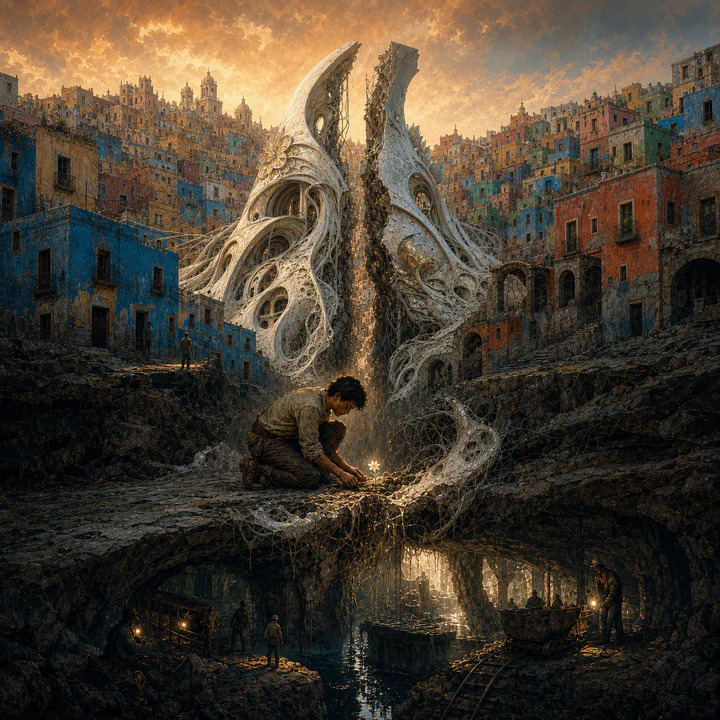
Small houses climbed the hillsides in tiers, their walls painted blue, yellow, rose, and orange. Flowers trailed from windowsills, and music sounded beneath the arcades. At dusk, the square filled with hand drums, strings, and the strike of heels against stone. People danced beside the fountains. Lovers kissed on balconies. Children were seldom seen, but flowers were everywhere.
At the center of the city stood Concordia Tower.
It consisted of two tall spires entwined around one another, as much plant as architecture. White ribs rose from the ground, and translucent, luminous petals unfurled along the walls. At night, the petals lit one by one, as though the whole city were breathing.
When lovers wanted a child, they climbed the Tower separately, one from each side.
During their ascent, the Tower replayed the memories of their love: their first meeting, their first quarrel, their first reconciliation, the first time they chose to remain together. At last they met at the summit, kissed, and made a wish.
If Concordia Tower responded, a flower opened somewhere on its walls or in the surrounding gardens.
A child was born from the flower.
The people of the Land of Happiness considered it the most beautiful way in the world to bring forth life.
Nor was the ascent a private matter between two lovers.
Each time a couple climbed, Concordia Tower read their shared memories and projected the brightest and most stable moments, those most capable of awakening a resonance of happiness, across its glowing petals. The entire city watched from the square, from windows and terraces, and from beneath the arcades.
They saw the lovers meet. They saw misunderstanding and reconciliation, hands joined during a long journey, and the instant of doubt and certainty just before the kiss at the summit.
For a little while, these stories made the city brighter.
The people of the Land of Happiness believed that a couple’s happiness did not belong to the couple alone. Once Concordia Tower magnified it, it became something the whole city could share. To climb the Tower was to ask for a child, but also to distribute happiness among everyone.
No one’s approval was required for a child.
Lovers climbed, kissed, and wished. If their happiness was stable enough, Concordia Tower flowered of its own accord. A child came from the bloom like a new branch grown from an event of happiness.
Children generally reached adulthood within a few days.
In the Land of Happiness, those days were called Bloomtime. Lovers could visit the gardens beside the Tower, listen with the child to a first song, watch a first dance, and teach the child to say their own name. But many lovers visited only once. Some never went at all.
This was not considered callous.
The people of the upper city had too much happiness to enjoy: the morning flower market, evening dances, choir rehearsals before festivals, and the long, radiant rituals of memory shared between lovers. Children came from flowers and soon walked into lives of their own. There was no long infancy, no burden of poverty, and no obligation to surrender years or decades of freedom for another life.
Lovers who wished to do so could stay with a child for those few days of Bloomtime.
If they did not, the child was never left unattended. Someone was always there to care for the newly awakened: there was music, sunlight, soft flooring, and small flower-shaped boxes filled with colored stones. Children unaccompanied by their lovers spent Bloomtime there.
For that reason, most lovers did not think of a child as someone who belonged to them.
They thought of the child as a new branch Concordia Tower had opened from an event of happiness. Where that branch would grow, and what it would become, did not seem like something any pair of lovers should hold in their hands.
The people of the Land of Happiness also understood, vaguely, that death was not the end. A person returned to Concordia Tower as light returned to a petal. Few asked too closely what happened afterward. The upper city remained bright day after day, and its people grew accustomed to entrusting both life and death to the Tower.
It was because of this trust that the upper city did not panic when flowers that should have opened aboveground recently failed to appear.
Some lovers grieved for a few days, then returned to dances and festivals. Some consoled themselves that if the Tower had not answered, it must have a reason that better served the happiness of all. Others simply found new lovers and prepared to climb again.
Very few kept asking where the children had gone.
Laia and Sol were among those few.
They, too, had once believed in everything the Land of Happiness promised.
Until their flower did not open.
II. The Museum Far Away
Laia and Sol had spent a long time away from the Land of Happiness.
They had visited worlds beyond it, seen cities without a Concordia Tower, met old people who fell ill naturally, and watched children grow slowly.
That last thing unsettled Laia most.
Those children did not become adults in a matter of days. They cried, crawled, learned to speak, fell down, and asked useless questions. Their parents spent years beside them, teaching them to walk, to eat, and to recognize danger, while enduring the same mistakes again and again.
At first, Laia thought it looked exhausting.
From outside a window in one distant city, she watched a child totter toward his mother. He took only three steps before falling into her arms. The mother looked tired when she smiled, but not impatient.
“So love can be slow,” Laia said.
“In our country, it would probably be judged inefficient,” Sol replied.
Laia did not laugh.
Later, beside an interstellar port, they visited a very small museum.
It had been built beside the wreck of an old spacecraft. The ship could no longer fly. Its silver-gray hull had burned black, and the edges of its hatch looked like wax melted and cooled again. It had once traveled among several worlds, carrying travelers, merchants, students, temporary workers, and families migrating with children.
The museum belonged to no king or general. It commemorated a traveler from elsewhere.
There was no towering statue in the central hall, only a few objects recovered from the disaster: a child’s blackened shoe, a warped hatch catch, a torn length of seat harness, and a small withered flower sealed inside a transparent case.
The flower made Laia stop.
It was tiny. Its petals had faded and curled at the edges, but its original shape was still recognizable. Laia knew the flower. Many like it grew at the foot of Concordia Tower. Before an ascent, lovers often picked one and pinned it to their clothing as a wish for departure and return.
Laia asked the museum keeper, “Why is this flower here?”
“The traveler carried it with her,” the keeper said. “Perhaps it came from her homeland.”
“Where was her homeland?”
The keeper shook his head.
“The records do not say. She was a traveler from elsewhere. She was aboard this ship for only one leg of its journey.”
The plaque explained that many years earlier, the spacecraft had caught fire as it approached the port. Passengers escaped through a damaged hatch while smoke and weightlessness alarms filled the corridors. A child was separated from his parents and pushed to the edge of the crowd. His safety buckle had jammed between the seats and would not come free.
The first person to stop was neither a relative nor a member of the crew, but a traveler who had already reached the evacuation passage.
She went back into the smoke, freed the child’s buckle, and pushed him toward the hatch. Passengers outside caught him and passed him from one pair of hands to the next. In this way, strangers carried the child piece by piece out of the ship.
Later, they found the child’s parents.
They also found the traveler.
She did not survive.
Laia stood before the blackened shoe and the withered flower. She felt solemn, but also bewildered.
“How can something like this be made into a museum?” she asked Sol.
Sol did not really understand either.
In the Land of Happiness, children were not lost in this way. They came from flowers, passed through a brief Bloomtime, and within days entered lives of their own. No parents searched for them through the smoke of a spacecraft. No stranger had to risk her life by returning down a corridor to release someone else’s child from a seat.
At the time, Laia thought the worlds outside must simply be so fragile and disordered that they had to attach great importance to such things.
But as she left the museum, she turned once more to look at the flower.
It seemed strange to find a flower from home so far away.
Later still, on a street in another distant city, she saw a child fall and cry for a long time. His mother crouched beside him. She did not immediately lift him, but kept showing him how to stand. The child’s face grew red with crying. The mother looked tired too, yet no one hurried them.
Later again, through the window of an ordinary home, Laia watched a father change the cool cloth on a feverish child’s forehead in the middle of the night. The child was no better the next day, nor the day after. A single illness changed the rhythm of the entire household.
Only slowly did Laia understand that in those worlds, raising a child was not a Bloomtime of several days. It was long, clumsy, repetitive, and full of uncertainty. Children could be lost. They could become ill. They grew slowly. They cost adults sleep, time, and freedom, and could make adults endure true loss.
That was why they commemorated the traveler.
Not because the child she saved was her own.
But because, in such a world, any child could be lost, and at the moment one child was being lost, someone had stopped.
Laia still did not understand completely.
She only knew that it was very different from the Land of Happiness.
III. The Root That Grew Downward
After returning home, Laia and Sol decided to climb the Tower.
They did not want only a child who would emerge from a flower and leave as an adult a few days later. They wanted to try what people beyond their country did: to come to know a child slowly, and to accompany him through Bloomtime, however brief it was.
Concordia Tower opened the two tracks for them.
Laia ascended on the eastern side, Sol on the western. The tracks passed through layer upon layer of luminous petals, the Gallery of Memory, and platforms open to the wind. The Tower replayed moments from their love: the embrace before their departure, an argument on a rainy night in another world, the blue harbor beyond a spacecraft window, and the moment they had stopped together outside that unfamiliar family’s home.
The memories were projected across the Tower’s petals.
People in the square looked up and applauded. They saw Laia pause outside a city window in a world beyond and Sol take her hand. They saw a brief flare of fire in the interstellar port, but it was only background. Soon the Tower showed the couple reconciling in foreign rain, and the petals softened into light once more.
At last, they met at the summit.
They kissed and made a wish.
No flower opened aboveground.
The officiant told them gently, “Sometimes Concordia Tower needs time.”
So they waited.
One month passed. No child.
Three months passed. Still no child.
After half a year, Laia began asking other lovers. She soon discovered that theirs was not the only flower that had failed to open. Many couples had kissed at the summit, made their wishes, and waited, only to be told that Concordia Tower had not yet answered.
Most had stopped asking.
Some said perhaps their happiness was not stable enough.
Some said one must not become too attached to the matter of children.
Some said that staring too long at an unhappy thing would only spoil one’s happiness.
Laia could not let it go.
In secret, she examined the gardeners’ ledgers from the days after their ascent. She found that the bud left by her and Sol had not withered. Normally, a bud that failed to open dimmed and fell within days. Theirs had not. Its outer petals had closed, but fine white roots continued to grow from its base, reaching into the depths of the Tower.
“Perhaps this is normal,” Sol said.
“If it is normal, why will no one explain it?” Laia replied.
They kept searching.
In the evasive words of old gardeners and Tower maintenance workers, they heard a name.
Elián.
Some said he was an eccentric observer of soil. Some said that from the moment he woke inside a flower, he had been unlike other children of the upper city. Others quickly learned music, manners, love, and dance. Elián was forever putting his hands into the earth.
Other children chased the caregivers’ dancing steps. He crouched beside flowerpots and searched the soil for insects.
Other children clapped when they heard music in the square. He complained that it was too bright and too full, as if something were pressing against his chest.
Other children cheered at the flowering ceremonies atop the Tower. He always looked instead at the fine white roots beneath the pots.
When people asked why, he could not answer. He only said, “When a flower does not open, perhaps you should look at the roots.”
As an adult, Elián seldom joined the dances of the upper city and rarely climbed to high places. He lived at the foot of Concordia Tower, making a living from odd jobs for gardeners, maintenance workers, and the old archive. The people of the upper city thought his happiness lay in out-of-the-way places. Unlike most of them, he was not easily illuminated by the square, the rituals of lovers, or festivals. Elián rarely argued.
The discovery of a transparent insect could make him smile.
A grain of mine dust mixed into the soil after rain could keep him crouching in the same place all afternoon.
He would lie beside a wall and listen to faint vibrations from somewhere far away.
He did not know why things in low places soothed him, or why the closer he came to the soil, the more clearly he heard something like a tender echo. The people of the upper city called it a peculiar habit. Elián had no better explanation.
When Laia and Sol found him, he was crouching beside a flower bed outside Concordia Tower, parting the wet soil.
He looked neither like a rebel nor a prophet. There was mud on his sleeves. With a small knife in one hand, he was carefully avoiding a transparent insect.
“Are you Elián?” Laia asked.
Without looking up, he said, “If you have come to ask why a child did not come out of a flower, I don’t know.”
Sol started. “How did you know?”
“Few people have come to ask me lately,” Elián said. “But those who make it this far usually have only one question left.”
Laia handed him the flowering record.
Elián studied it for a long time.
Then he said, “This flower is not dead.”
Laia’s fingers tightened.
“Then where is it?”
With the tip of his knife, Elián drew aside the earth and revealed a fine white root extending downward.
“Perhaps it did open,” he said. “Perhaps it simply did not open upward.”
IV. Beyond the Heavy Door
That night, the three of them slipped into the gardens of the Burden-Bearer’s residence.
What people called the Burden-Bearer’s residence was neither a separate palace nor a monastery. It spread around the base of Concordia Tower and included the gardens below, forming a single place where the Burden-Bearer governed, cared for children, and joined his consciousness to the Tower. Ordinary residents of the upper city rarely entered. They knew only that he conducted affairs of state there, and that somewhere inside he connected his mind to the Tower.
The Burden-Bearer was the highest governor of the Land of Happiness.
He was elected by the citizens of the upper city. This was the democratic tradition of which the country was proudest: its governor was not someone who carved out privileges for himself within the happiness calculus, but someone chosen by the people to bear the problems left behind by Concordia Tower’s operation.
Upon taking office, every Burden-Bearer had to swear before the Tower that he would withdraw from the happiness calculus. From that day forward, neither his happiness nor his suffering would count toward the happiness or suffering of the country. He could not make the Tower favor him, nor could he turn his own pain into a reason of state.
That was why he was called the Burden-Bearer.
The people of the upper city were accustomed to hearing his name at festivals and in public notices. They knew he lived at the residence to handle matters unsuited to dances, lovers’ rites, or ordinary caretakers. Most of them, while they were happy, gave little thought to how the institutions behind that happiness actually worked.
But Laia and Sol had no attention to spare for institutions now.
They followed Elián along a drainage channel at the edge of the garden. Elián knew the roots here. He knew which paving stone was loose, beneath which stretch of flower wall the soil ran deepest, and which kind of black grit could not have come from the garden itself.
“Mine dust.” Elián rubbed the black powder between his fingertips. “There shouldn’t be this much of it here.”
“Where does it come from?” Laia whispered.
“Somewhere very deep.”
They dug along the anomalous roots. The soil grew darker, flecked with tiny shining fragments of stone. When Sol pried up a concealed slab, a faint sound rose from below.
It was not water.
It sounded like a child crying.
Laia went rigid.
She lay beside the slab and pressed her ear close.
The sound came again.
Clearer this time.
There was a chamber below.
Sol was about to pry further when the garden lamps flared on.
The Burden-Bearer stood a short distance away.
He had brought no guards, and he did not rebuke them. Moonlight fell across his white robe. He looked thinner than he did in the portraits in the square, and far more tired.
“Do you know what you are digging into?” he asked.
Laia rose to her feet.
“We are looking for our child.”
The Burden-Bearer lowered his gaze to the exposed white root.
“You are digging into the nerves of the country.”
Laia stepped toward him.
“What is down there?”
He studied the three of them, as though judging how much they already knew.
At last he said, “Come with me.”
They followed him into the residence.
Laia had imagined it would resemble a government building: long tables, documents, silent attendants, heavy doors, and walls crowded with portraits of former Burden-Bearers.
Instead, the first thing she heard was children’s laughter.
Most of the residence belonged to the Sunlit Flower Court.
Small rooms opened on both sides of a long gallery. Soft patterned mats covered the floors, and the walls were painted vivid blue and yellow. Several children who had only recently awakened from flowers sat at low tables, arranging colored stones into the shape of Concordia Tower. Others gathered around young caretakers to learn a clapping rhythm, their heels striking the wooden floor with awkward thuds. Still others lay by the windows, watching white rootlets slowly curl around the garden steps.
They all looked too new.
Some could barely speak. Some had already grown into adolescent bodies. Others were nearly adult in height. Growth during Bloomtime was swift: body, language, and basic knowledge matured within days. Yet these children still lacked the time that came only from having truly lived in the world. They did not know what they liked, how to choose, or how a relationship might unfold slowly.
A child came running from the other end of the gallery and nearly collided with the Burden-Bearer. At the sight of the white robe, he immediately straightened.
“Lord Burden-Bearer.”
The Burden-Bearer bent and stroked his hair.
The gesture was practiced, even tender.
Laia stared.
She suddenly understood that the Burden-Bearer did not merely sit above the city and calculate happiness. Here, at least, he passed children every day. He watched them wake from flowers, watched them grow within days, watched them be sent to different places.
She no longer knew what such a man would see when he looked at a child: part of the work of government, part of the Tower, or something he was obliged to send away with his own hands.
It was not that he had never seen children.
He had seen too many.
They crossed a bright, spacious room where children were learning how to vote. A caretaker gave them paper flowers to place inside a little flower-shaped box.
“What does voting mean?” the caretaker asked.
The children answered together:
“It means we choose happiness together.”
At those words, Laia’s fingers went cold.
The Burden-Bearer did not stop.
“This is the Sunlit Flower Court,” he said. “Children guided aboveground spend their Bloomtime here.”
Sol looked at them. “They leave after a few days?”
“Yes.”
“Do they know where they will go?”
“They are assigned to the place best suited to them.”
Laia asked, “Who decides what is suitable?”
The Burden-Bearer glanced at her.
“Concordia Tower.”
They went farther inside.
The Burden-Bearer’s offices were plain, almost without ornament. Beyond them the air grew cold, the fragrance of flowers thinned, and more fine white roots appeared along the walls. A heavy partition muffled the children’s laughter behind them. In its place came a low sound like water moving somewhere far beneath the earth.
They stopped before a heavy door.
A weak, cold light shone beneath it.
Laia heard children again.
“This is the first level below the Tower,” the Burden-Bearer said.
Sol lowered his voice. “What is it?”
“Children guided underground are cared for here.”
Laia nearly lost her balance.
“Flowers bloom underground too?”
“Yes.”
“Did our flower bloom there?”
The Burden-Bearer was silent for a moment.
“It has been happening often of late.”
“Why?”
At last, he gave them the first layer of the truth.
Several months earlier, a serious accident had struck the underground mines. Many underground workers had died, leaving shortages in both root-zone maintenance and mining. Concordia Tower needed to replenish the underground population. In recent months, many children whose flowers would otherwise have opened aboveground and led them into the Sunlit Flower Court had instead been guided to the first level below the Tower.
Sol went pale.
“A mining disaster? Why was nothing announced?”
The Burden-Bearer’s voice remained calm.
“An announcement could not restore the dead or repair the mines. It would only bring fear, sorrow, and guilt to the citizens above, diminishing the happiness of many.”
Laia stared at him in disbelief.
“So you concealed it?”
“We prevented a useless pain.”
Laia pointed at the door. “And the children behind it? Because they are useful, you can send them down?”
“The underground requires people to keep the country functioning. Those above have always had a vague awareness that underground maintenance zones exist. They simply have no need to know every detail.”
“They are our children.”
For the first time, the Burden-Bearer frowned.
“Children are not the property of lovers. Every child belongs to Concordia Tower.”
He paused, then went on.
“You see deprivation because you see only the names and relationships of this one life. The Tower sees a longer course. Those above today may go below in the next life; those below today may next awaken from flowers above. Memories are erased. Identities change. Every person’s happiness and suffering enters the calculus with exactly the same weight. That is what makes it fair.”
Before they left the residence, Laia asked one more time:
“Which one is our child?”
The Burden-Bearer did not answer directly.
“Once a flower is guided below, the child awakens on that level. After birth, former relationships are not retained. Even if I told you which child came from that flower, he would no longer be your child in the sense you mean.”
“You took him away from us,” Laia said, “and now you tell me he does not belong to us?”
“He never belonged to you. You merely took part in his flowering.”
Laia could barely remain standing.
Elián had said nothing.
He looked at the heavy door. “Why can’t the Sunlit Flower Court be connected to the level below?”
“Connection would breed pity and envy,” the Burden-Bearer replied. “Children above would suffer at the sight of children below. Children below would suffer more at the sight of those above. Separation is not punishment. It prevents unnecessary pain from occurring.”
He paused.
“That is also why they are not taken to the square to learn how to vote, and why their names do not appear on the electoral rolls. Underground children need to know the mine passages, the heat wells, and the roots. They do not need to know things that would only invite comparison.”
Elián asked, “You mean people underground cannot vote?”
The Burden-Bearer looked at him.
“Voting is not what makes a person human. Everyone who awakens from a flower is counted by Concordia Tower with equal weight. Even I cannot alter that.”
After another pause, he continued.
“Voting is merely another ritual through which people feel they are taking part. Democracy is our tradition, and it accords with the Tower’s calculus. For the citizens of the upper city, it heightens participation, responsibility, and happiness. For citizens underground, it would heighten comparison, resentment, and helplessness. A clear knowledge that they cannot change their circumstances would only diminish their happiness. Not every right increases happiness under every condition.”
“If nothing can be changed,” Elián said, “why do the people above need to vote?”
“Because they are happier believing that they can.”
Elián spoke softly. “So the illusion of those above is called civic responsibility, while the clarity of those below is called a risk of suffering?”
The Burden-Bearer did not answer at once.
After a moment he said, “Elián, you have not yet seen the whole.”
Laia asked, “You see those children every day. Doesn’t it hurt you?”
“I have renounced the right to let my suffering enter the total.”
For the first time, Elián thought that perhaps the Burden-Bearer was not heartless.
He had simply removed his heart from himself.
That night, Laia and Sol sat at the foot of Concordia Tower for a long time without speaking.
Laia remembered the blackened starship beside the spaceport, the little dried flower from its homeland inside the display case, and the question she had once failed to understand:
Why could such a thing become a museum?
Now she understood a little.
Because in some worlds, children truly could be lost.
And now the Land of Happiness had lost children too.
“What if we never find him?” Laia whispered.
Sol did not answer.
“If every child below might not be ours, do we keep looking?”
Sol looked up at the closed buds along the Tower.
“You already know the answer.”
Laia closed her eyes.
“Then we cannot look only for our own child.”
V. Please Don’t Tell Me
After leaving the residence, Laia and Sol began by looking for people.
They sought out other lovers who had also waited for flowers that never opened.
At first Laia thought it would not be difficult. All they had to do was tell them that the flowers had not died, but opened downward; that a mining disaster had occurred below and many children had been sent behind the heavy door. Once they laid out the gardeners’ ledgers, the dates, and the white roots growing downward, surely those who had lost children would stand together.
Sol made a list.
There were no children’s names on it, only the secret marks gardeners had left in the margins of their ledgers: which flower had failed to brighten, which white tendril had pierced the earth, which petal bore mine dust that should not have been there.
Behind every unopened flower had once been two lovers waiting.
Records in hand, they knocked on one door after another.
The first pair listened, then sat in silence for a long time.
“Can you prove it was our child?” the woman asked.
“Not yet,” Laia said. “But your flower also sent roots downward.”
The man lowered his voice. “If you can’t prove it, why should we know?”
The second pair refused even to look at the records.
“The Tower did not respond. That means it was not our happiness,” they said. “We have accepted it.”
A third person went pale halfway through Laia’s account and finally begged her to stop.
“It isn’t that I feel no grief,” he said. “But if knowing will only hurt more, I would rather trust the Tower.”
Another had already found a new lover and was preparing to climb the Tower again. He stood in the doorway and would not let Laia enter.
“What do you want us to do?” he asked. “Go to the square and weep? Ruin everyone’s happiness? If the child has already grown up underground, if he no longer remembers us, what exactly do you hope to recover?”
Laia had no answer.
They crossed street after street. As the hours passed, the list in Sol’s hands came to resemble a blank sheet of paper. There were many names, but few people willing to stand beside them.
That night, they sat in the hut the old gardener had left behind.
“I thought they would want to know,” Laia said.
Sol folded the list.
“Some of them do. But they are more afraid that even after knowing, they still won’t be able to do anything.”
“Then the underground isn’t hidden only by the Burden-Bearer.”
“The people of the upper city cover it over themselves.”
The hut was silent for a long time after that.
That evening, Laia and Sol spread out every anomalous flowering record they had found.
Sol wrote the sequence down, line by line:
The mining disaster.
A shortage in root-zone maintenance.
More dark buds on the Tower, closed and unfallen.
Fine roots growing downward from the base of the buds.
More and more children crying behind the heavy door.
No announcement in the upper city.
The fluctuations in happiness across the square remaining stable.
He studied the records.
“The accident did not end,” he said.
“Then what happened to it?” Laia asked.
“It became the new normal.”
Laia remembered the little blackened shoe in the Museum of Far Voyages.
She had not understood then why someone who saved children could be given a museum.
Now she did.
If no one stopped, if no one preserved the names, if every loss was explained as something “the whole required,” then the next loss would become easier.
“We have no way to prove which child is ours,” Laia said.
Sol nodded.
Laia looked out at Concordia Tower.
Its walls were shining that night. The memories of another pair of lovers were playing across the luminous petals. People in the square watched with tender smiles.
“They will watch the Tower,” Sol said suddenly.
Laia looked up too.
“They won’t open their doors. They won’t listen to us or stand beside us. But they will watch the Tower. Every time someone climbs, they watch.”
Laia understood.
“Concordia Tower reads the memories lovers share.”
“And broadcasts them to the whole city,” Sol said.
Laia looked down at the records on the table: the flowers that had not opened, the roots descending into the earth, the mine dust, the crying beneath the heavy door, and the blackened child’s shoe in the museum.
“Then let the Tower speak,” she said.
From that day onward, they no longer searched for only one child.
Laia recorded the crying, the petals, the cold light beneath the door, the little hands grasping at the wall. She also recorded the faces of those who asked not to know.
Sol recorded dates, secret marks in the gardeners’ ledgers, the direction of roots, samples of mine dust, and every blank in the official record.
Night after night, they recited it all to each other.
Laia said, “There is crying beneath the heavy door.”
Sol said, “The same page of the ledger: ninth day, bud unfallen, roots forming at its base.”
Sol said, “Three days after the mining disaster, the shortage of underground maintenance workers increased.”
Laia said, “After that, no new children appeared in the Sunlit Flower Court, but there were new children on the level below.”
They were not trying to persuade one another.
They were turning scattered discoveries into a shared memory.
Because Concordia Tower read the memories lovers shared.
In the past, lovers climbing the Tower had carried memories of first meetings, kisses, quarrels, reconciliations, and wishes.
Laia and Sol would carry the testimony of an accident.
By dawn, the underground was no longer merely the crying Laia had heard or the records Sol had assembled.
It had become something they carried together.
VI. Seeing the Whole
That night, Elián returned to the grounds of the Burden-Bearer’s residence.
This time, he brought neither Laia nor Sol.
During their first intrusion, he had memorized the course of the roots inside the residence. Several maintenance passages beneath the gardens led to the perimeter of the Burden-Bearer’s joining chamber. He did not know whether he could get inside, or what would happen if he did.
He knew only what the Burden-Bearer had said:
You have not yet seen the whole.
Then he would go and see it.
The joining chamber resembled a windowless conservatory. At its center stood a chair woven from bundles of white roots. Fine tendrils reached from its back like clean, supple nerves. This was where the Burden-Bearer joined himself to the depths of Concordia Tower.
As Elián approached, the fine roots lifted slightly, as though trying to recognize an unfamiliar body.
He sat down.
When the roots touched the back of his neck, he expected pain.
There was none.
Only the sensation of an immense fall.
Then the entire country opened before him.
It did not open like a map, but like a flower sliced through its center, every layer exposed at once.
The colored houses, the central square, the kissing terrace at the summit, the luminous petals along the Tower, the Sunlit Flower Court, the level underground, the mines, the heat wells, the subterranean railways, the Burden-Bearer’s residence, the flower boxes used in elections, the terraces where lovers kissed: all became transparent layers.
People no longer looked like people.
Each was a light-vein passing through time.
They were born from flowers and entered into kisses, dances, study, elections, work, journeys, old age, and death, before returning once more to Concordia Tower. Each time they opened anew, memory broke away like a thin membrane cut clean through. Old names, old relationships, old stories: all dispersed.
But the light-veins did not break.
They carried some deeper shape forward.
Some flared when they kissed at the summit, like lamps opening in the wind.
Some flashed together with countless others as they voted in the square, forming a warm tide of light.
Some grew swiftly in the Sunlit Flower Court and, within days, flowed into the music, festivals, and romances of the upper city.
Others turned downward. They passed through the first level underground, then followed the root passages into the mines, where they became subdued, slow, and dim.
Elián saw a mining disaster.
In ordinary time it was an instant: a collapse, dust, screams, black water flooding the tracks.
Here, it was not an instant.
It was a dark convulsion spreading from a single point underground. The dead miners became dozens of light-veins abruptly severed, then drawn back into Concordia Tower. Gaps appeared in the root zone. The maintenance of heat wells, the transport of ore, structural repairs, the clearing of root bundles: a chain of dim vacancies spread outward.
Then Elián saw fine roots emerge all at once from the bases of many buds that would otherwise have opened aboveground.
Flowers that might have opened upward were guided below.
It was not anger. Not punishment. Not even an order.
From within this vision, it resembled a bodily adjustment: where people were lacking, new lives were needed; wherever the total loss of happiness would be lower, more of the necessary burden was placed.
Then Elián saw the upper city.
Dancing in the square raised great sweeps of light-veins together. When lovers kissed, flowers on the Tower and in the gardens burst open like constellations. On election day, the light-veins of voters drew close to one another and produced a bright, steady ripple called civic consciousness.
The ripple was beautiful.
Elián had to admit that it truly was beautiful.
Then he saw the underground.
Its light-veins did not blaze that way. They were darker, heavier, less inclined to rise.
Elián tried to follow one of them.
When it first entered the mine passages, music filtering down through the walls could still brighten it a little. Then came darkness, thunder, and exhaustion, day after day. A cave-in sent it plunging; after its wounds healed, it never returned to its former height. In time, even the music could no longer stir it.
It died in the mine, returned to Concordia Tower, and awakened from another flower. Its former name had vanished. The sound and pain of the collapse no longer belonged to its new memory. Yet the light-vein had not regained its former shape. It still drooped, like a branch bent under a great weight that could never again straighten.
At the next division, Elián watched it arrive before the white root bundles beside another light-vein. Concordia Tower did not value one child less than the other. Every brightening and every dimming in both veins entered the whole with exactly equal weight.
But they were no longer equally capable of happiness.
The other light-vein dimmed sharply as it approached the underground. The wounded one only sank a little further. Leaving the first above and sending the second below would make the sum of all light-veins slightly brighter.
And so the white root bundles parted.
The wounded vein descended again.
Concordia Tower recorded its brightness and darkness in every life. But it never turned back for the sake of any one vein to ask why it had ceased to hope, or why happiness found it harder and harder to kindle. At the moment of division, the Tower read only how much happiness it could feel now, and how much would be lost if it endured a given pain.
Elián followed a second vein, then a third. They passed through different mines and suffered different injuries, yet traced the same arc back underground, again and again. Each life of labor and fear made them less able to rise. Each failure to rise became the reason for sending them down once more.
No one ordered them to remain below forever. Yet unless something entered from beyond the calculus and taught them to feel happiness again, the cycle had no exit.
Elián wanted to object, but he had no language with which to do it.
Nothing here appeared in human words. There was no “cruelty,” no “fairness,” no “oppression,” no “sacrifice.” There were only the flow of light, the density of pain, the height of happiness, the spread of fluctuations, and the balance of the whole.
Suddenly he understood why the Burden-Bearer always spoke as he did.
If this was what a person saw every day, it would indeed become difficult to see only one face, one hand, one cry.
Elián was almost swallowed by the whole.
He began to forget why he had come.
He saw the suffering of too many people, and the happiness of too many. Every decision tugged at some other field of light. Every compensation brought another loss. Every door opened onto more things pouring through the doors behind it.
Then he heard three beats.
Thump.
Thump.
Tap.
The sound was faint, as though it came through a very thick wall.
The vast vision abruptly contracted.
He saw a side passage underground. The mine lamps were dim, the stone walls damp. White roots hung from the cracks. A man stood beside the wall holding a child’s hand.
Music could barely be heard somewhere above them.
“I can’t hear it,” the child said.
“Close your eyes.”
The child obeyed.
“Don’t listen to the mine carts. Don’t listen to the pipes. Listen for something higher up.”
After a long while, the child said, “There’s a little of it… thump, thump, tap.”
The man smiled.
“That isn’t a mine cart,” he said. “It’s dance music.”
“What use is dance music?”
The man looked down at his mining boots. They were heavy and caked in black dust.
“None,” he said.
“Then why learn it?”
The man was silent for a long time.
“Because some things are useless,” he said at last, “but people cannot live without them.”
He taught the child to bring down his heel.
The first step was too heavy, as though he were striking stone.
“Don’t smash it down,” the man said. “You aren’t breaking rock. You’re telling the ground you are here.”
The child tried again.
Thump.
“Again.”
Thump.
“Toe.”
Tap.
Elián watched the child, his throat tightening for reasons he could not understand. He knew neither the child nor the man. Yet when the man tapped the rhythm into the child’s palm, Elián felt as though his own body remembered those three beats.
The man raised his arms and slowly opened them out from his chest, turning his wrists and unfurling his fingers one by one. The side passage was too narrow. His fingertips brushed through mine dust and left a pale gray arc on the wall.
The child stared.
“What is that for?”
“Your hands have to dance too,” the man said. “Don’t hold them so stiffly. People in the upper city say your fingers should open like a flower.”
The child imitated him clumsily, like a newly grown branch. The man laughed. “Still looks too much like a mine crane.”
The child protested. “You don’t look like a flower either.”
The man froze, then gave a quiet laugh.
They danced a very small dance beside the wall.
There were no swirling skirts, no applause, no sunlight. Only mine lamps, roots, stone walls, and music from above that could scarcely be heard.
“What is a dance partner?” the child asked.
“Someone who listens to the same music with you.”
“Are you my dance partner?”
The man looked at him for a long time.
“Yes,” he said. “Tonight I am.”
Then the scene broke apart.
Elián saw only the man being sent to a deeper mine and the child being taken away for assessment. Records flowed along the edge of his vision like cold water:
Encouraging unnecessary aspirations in new lives.
Of no benefit to underground adaptation.
Later, the man returned injured.
“Will we still dance?” the child asked.
The man sat beneath a mine lamp and did not answer for a long time.
The child lowered his head.
Then the man tapped three times against his knee with raw knuckles.
Thump.
Thump.
Tap.
“Softly,” he said. “Don’t let them hear.”
When Elián awoke, the Burden-Bearer was standing in the doorway of the joining chamber.
The fine white roots withdrew from Elián’s neck. He fell to his knees, gasping as though he had just been dragged from the water.
The Burden-Bearer did not call for anyone.
Nor did he ask how much Elián had seen.
He only watched him. After a long while, he said:
“You have seen my daily life.”
Elián looked up.
The Burden-Bearer’s voice was soft, but without anger.
“It is not easy work.”
Elián said nothing.
The Burden-Bearer entered the chamber and rested a hand on the chair woven from roots.
“Those lights you saw, the breaking and returning, the way one measure of pain spared here extinguishes two measures of happiness elsewhere: I see it every day.”
Elián understood then. The Burden-Bearer was not ignorant of the underground, nor blind to the ways light-veins rose and fell through repeated allocations. He simply regarded their long distortion as adaptation, as a fact already absorbed by the calculus, without asking what had bent them into that shape.
The Burden-Bearer looked at him.
“You saw it too, didn’t you? Not every door opens onto freedom. Sometimes opening a door reveals only more suffering, more things that people cannot bear once they have seen one another.”
Elián pulled himself upright against the wall.
“Now you know why I said you had not seen the whole.”
Elián’s voice was hoarse.
“I saw it.”
“And what did you see most clearly?”
Elián wanted to say the mining disaster. He wanted to say the underground, and the courses that bent downward life after life.
But all he could hear were those three beats.
Thump.
Thump.
Tap.
“A useless dance,” he said.
The Burden-Bearer fell silent.
Elián walked past him.
The Burden-Bearer did not stop him.
Only when Elián reached the doorway did he speak again.
“If you are going to the square, remember this: people need more than truth. They need a way to live after the truth.”
Elián did not turn.
“Seeing one another will not make suffering diminish on its own,” the Burden-Bearer said.
Elián paused.
“But at last it will no longer be left only below.”
VII. Testimony of an Accident
It was still dark when Elián found Laia and Sol.
Sol spread a rough diagram across the table.
He and Elián had pieced it together from old archives, gardeners’ notes, and the courses of the roots. It showed the summit of the Tower, the Gallery of Memory, the Sunlit Flower Court, the joining chamber, the level underground, and the hollow wrapped in thick roots between the Court and the level below.
“We went to the others whose flowers never opened,” Laia said.
“Will they stand with us?” Elián asked.
Sol shook his head.
“Some are afraid. Some don’t believe us. Some already know a little, but begged us not to tell them any more.”
“It isn’t that they don’t know,” Laia said. “They are asking us not to make them know.”
Elián was silent.
Sol pointed toward Concordia Tower.
“That makes the square useless. If they don’t come, or refuse to listen, the truth still won’t reach them.”
“But they will watch the Tower,” Laia said.
Elián looked up.
“They watch every ascent,” Sol said. “It is the gentlest and safest thing in the Land of Happiness, the one thing no one feels the need to guard against.”
“Then let the Tower speak,” Laia said.
Elián studied them.
“You want to use the ascent to broadcast the underground?”
“It won’t be us broadcasting,” Sol said. “It will be Concordia Tower. That is what it has always done.”
“Lovers used to carry happy memories up with them, so the Tower showed happiness,” Laia said. “But what if we carry what lies behind the heavy door? The mine dust? The children crying?”
Elián looked up at the Tower.
“Happiness across the city will fall.”
Sol nodded.
“Sharply, at least for a while. The Gallery of Memory was built to increase happiness. It has always amplified kisses, reconciliations, wishes. But if it amplifies the museum of an accident, the crying behind the heavy door, the training of underground children, the faces of people saying, ‘What good would knowing do?’…”
“The people watching will not be happier,” Laia finished.
“Something will happen to the Tower,” Elián said. “The Burden-Bearer and the maintenance workers will have to stabilize it.”
Sol pointed to a blank space enclosed by roots on the diagram.
“I checked the old gardeners’ notes. When an ascent begins, Concordia Tower decides whether the new life will go upward or downward. At that moment, the branching root bundles between the Sunlit Flower Court and the underground level begin to move. They are not only conduits. They are the sinews that support the Tower and the floor of the residence. The sealed space between the levels opens briefly.”
Elián looked at the hollow on the page.
“So while you create a disturbance above, I enter from below.”
“We make everyone see,” Laia said.
“And you make sure it can never be closed again,” said Sol.
Elián was silent for a long time.
“What if we fail?”
“Then, for at least one moment, the children will be heard crying,” Laia said.
Elián looked at her.
Her voice was soft but steady.
“I used to wonder why someone who saved children could be given a museum. Now I understand a little. If everyone calculates first, then the child is already lost.”
Elián asked no more questions.
VIII. A Useless Dance
They chose the Moonflower Festival.
It was one of the grandest celebrations in the Land of Happiness. At night, the whole city gathered in the central square to watch a new pair of lovers climb the Tower. The Gallery of Memory opened to everyone, and together they watched the lovers’ story of happiness.
By dusk, the square was crowded.
Everyone expected an ordinary ascent.
Laia and Sol did not immediately set foot on the stairs.
First, Elián climbed onto the white stone rim of the fountain.
He raised no petal and shouted no slogan.
“I want to tell you a story,” he said.
At first, the people in the square were merely curious.
The Burden-Bearer stood on the terrace of his residence, watching from a distance.
Elián’s story was about an underground child, and about an underground miner.
“The man was not originally from below,” Elián said.
“He once lived in the upper city, and once had a lover. Together they left the Land of Happiness and traveled through the worlds beyond. They saw children take years to grow. They saw parents spend those years beside a child, teaching it to walk, to speak, to ask questions.”
“The woman loved children like that. She said she had never known that love could move so slowly.”
Laia lifted her head among the crowd.
Elián continued.
“They also visited memorials. The woman may never have fully understood why people beyond our country feared losing children so deeply, but she remembered the names inscribed there.”
“When she left the Land of Happiness, she carried a little flower from beneath the Tower. She said that if she never returned, the flower should remember for her: she had set out from a place very skilled at calculating happiness, to see how other worlds lived.”
Laia remembered the burned starship beside the spaceport and the dried flower in the display case.
She could not know whether it was the same flower. Many travelers from the Land of Happiness carried flowers from home to distant worlds.
Yet in that moment, she felt things separated by a great distance touch gently together.
“Later, their starward journey ended in an accident. The woman died. The man returned alone to the Land of Happiness. He came back to the upper city, but he could no longer draw happiness from it. Music, flowers, dancing, kisses, festivals: all seemed to reach him through thick glass. They could no longer kindle him.”
Elián looked at the Burden-Bearer.
“And so Concordia Tower judged that the man produced too little happiness in the upper city. He was assigned below.”
The square grew quiet.
“Underground, he became a miner. There was no square there, no sunlight, no dances at the summit. But one day, beside a wall beyond the heavy door, he heard music filtering down from above.”
Elián paused.
“It was faint. It passed through floors, stone walls, roots, and mine dust until only a rhythm remained.”
Thump.
Thump.
Tap.
“The rhythm made him remember his dead lover.”
Elián’s voice dropped.
“He remembered how they used to dance in the upper city. How she pretended not to know the steps, just so he would teach her again. How she once said, in a world beyond our own, that if they ever had a child, they should teach it not only the dances of the upper city, but dances from other places too.”
“Later, a child was born from a flower underground. By rule, the child was to be taught to avoid mine carts, recognize cave-ins, conserve strength, and ask no unnecessary questions. Within days, he would grow into a miner and enter the passages like every other child below.”
“But the man did something else.”
“He brought the child to that wall and taught him to listen for the music above. He taught him to distinguish a mine cart from a dance, to bring down his heel, and to tell the ground with his body: I am here.”
Elián did not describe the dance again.
Yet many could already imagine it: no sunlight, no swirling skirts, no applause. Only mine lamps, roots, stone walls, and a trace of almost inaudible music filtering down from above.
“The man did not do this because it made him happy. He did not become happier. According to the Tower’s records, life in the upper city still could not kindle him, and he remained unsuited to it.”
“But he gave the child the little he had left.”
“He gave a child who was meant to learn only how to enter a mine what remained of the dances he had once shared with his lover.”
There was no sound in the square.
“They were discovered,” Elián said. “The man was sent to a deeper mine, and the child was tested ahead of schedule. The record read: Encouraging unnecessary aspirations in new lives. Of no benefit to underground adaptation.”
He looked at them all.
“I do not remember this story.”
“Nor was that child the person I am now. Memory was severed. The individual changed. But the course that later led to me once belonged to that child underground.”
A murmur moved through the square.
“Why was I born in the upper city? Not because I belonged here to begin with. I was born here because someone cared for that underground child. Below, he learned something useless: to hear music, to dance, to wait for the next beat. He regained the capacity to feel happiness.”
“Concordia Tower saw that capacity, and later it sent the course that became me above.”
He looked down at his hands.
“It is not that I cannot be happy. A transparent insect in the soil makes me smile. I can crouch for an entire afternoon over the smell of mine dust after rain. A low vibration far beyond a wall can make me feel at peace. But you love the music in the center of the square, and I cannot bear its volume. You love flowers opening at the Tower’s summit, and I always want to look at the roots. You feel whole in kisses and elections. I have always felt that the entrance to my happiness lies somewhere lower, darker, and quieter.”
He raised his head.
“I thought these were peculiarities. Now I know they are not. They are the shape the underground left in me, and the shape left by someone who once cared for me.”
The crowd was so still that no one seemed to breathe.
“If care can pass through memory and leave a mark,” Elián said, “then so can trauma.”
“What I saw inside Concordia Tower was not only the child in this story. I saw many light-veins. They were worn down underground. They died, lost their memories, and awakened from flowers again. Their new names knew nothing of what had happened before, but happiness could no longer kindle them as easily as it once had.”
“We all know that after death we return to Concordia Tower and are born again from flowers. Memories are erased, names are changed, identities begin anew. That is why you believe the system is fair: those above today may be below next time; those below today may be above. No one possesses happiness forever, and no one suffers forever.”
He turned toward the Burden-Bearer.
“But there is something you have failed to see. Memory breaks; trauma does not break completely. Neither does nurture. Concordia Tower truly does count every child equally. No one’s happiness weighs less than another’s. But it counts only how much happiness we can still feel now. It does not ask why we became this way.”
“Life underground lowers the expectations of some light-veins. It numbs them, making happiness harder and harder to feel. At the next division, the Tower sees that another child would lose a great deal of happiness below, while the wounded child would lose only a little. To make the sum of everyone’s happiness greater, it sends the wounded child down again.”
His voice softened.
“The child is wounded once more. Next time, he appears even better suited to the underground. No one declares that he must remain there forever, but within this calculus there is no longer a path by which he can leave.”
“The Tower does not send people to the places that suit them. It first allows trauma to make them better able to endure the underground, then treats that trauma as proof that the underground suits them.”
At last, the Burden-Bearer descended from the terrace.
The crowd opened a path before him.
He stopped in the center of the square.
“You carry one story,” he said. “I bear them all.”
“I can stand here only because a man underground broke the rules and taught a child a useless dance,” Elián replied, “not because the Tower was fair to begin with.”
“Would you have me take more happiness from every other child for the sake of that one?”
Elián shook his head.
“I would have you admit that what you call impartiality already favors those who find happiness more easily. You let people whose capacity for happiness has been diminished by trauma continue to suffer, then say their suffering costs less.”
Someone in the crowd shouted, “Then what are we supposed to do? What about the mines? How will the city function without anyone below?”
Another voice cried, “If there is no Burden-Bearer, who will decide for everyone?”
The Burden-Bearer turned to the crowd.
“Do you hear him?” he said. “He says no one should decide for everyone. It sounds beautiful. But do you know what it means? It means you are asking not only for truth, but for chaos. You are asking not only to open the door, but to face all the anger, envy, hunger, and fear beyond it.”
He looked at Elián again.
“Seeing one another will not make suffering diminish on its own.”
“No,” Elián said.
The Burden-Bearer faltered.
“I do not believe that overthrowing this system will make suffering vanish,” Elián continued. “But we can no longer let it hide all our pain in the same place.”
The square did not cheer.
It broke apart.
Some people wept. Some applauded. Some left in anger. Others sank to their knees, uncertain for the first time whether the happiness they had trusted all their lives could still be called happiness.
Then Laia and Sol walked toward the stairways on opposite sides of Concordia Tower.
The Burden-Bearer turned.
He understood.
“Stop them,” he said.
But it was too late.
The Moonflower Festival ascent had begun.
IX. Cries Along the Tower
Laia and Sol climbed Concordia Tower once more.
Everyone in the square watched them.
Some thought they meant to make another wish. Some thought they would ask the Tower to return their child. Others already understood that it would not be so simple.
Before the ascent, Laia had said to Sol, “I still want that child.”
“So do I.”
“But if we ask only for him, the Tower will keep sending other children below.”
Sol said nothing.
Laia remembered the Museum of Far Voyages.
At last she understood: the people beyond their country did not memorialize death itself. They memorialized the moment when a child was swallowed by smoke and weightlessness alarms, and someone did not first ask whose child it was.
“Then we won’t climb carrying only a wish,” she said. “We’ll carry testimony.”
Now the tracks on both sides of Concordia Tower had opened.
Laia ascended from the east. Sol ascended from the west.
At first, everything unfolded as it had before.
The Gallery of Memory lit up. The luminous petals along the Tower opened layer by layer. The people in the square saw Laia and Sol’s first meeting, their embrace before leaving the Land of Happiness, their reconciliation after a quarrel on a rainy night in an outside city.
The crowd quieted.
The images were still beautiful.
Concordia Tower magnified the happiness of two lovers, and it moved through the square like warm water. Shoulders loosened without their owners noticing. Some even began to believe that this ascent might restore the familiar order: the lovers would kiss; a flower would open on the Tower or in its gardens; the city would once more receive a story it knew how to bless.
The Tower continued reading.
It saw Laia and Sol pause outside a window in another city. It saw a child totter toward his mother. It saw Laia say: I never knew love could move so slowly.
The petals on the Tower glimmered.
Then Laia refused to let the memory glide toward the kiss.
She took herself back to the little memorial beside the spaceport.
A burned starship appeared across the petals.
It stood in a hall of wreckage, its silver-gray hull blackened by fire. The hatch looked like wax melted and hardened again. Inside the display cases lay a charred child’s shoe, a warped hatch clasp, a torn safety harness, and a dried little flower sealed in a transparent box.
The music in the square missed a beat.
The people saw the ship catch fire before docking. Smoke and weightlessness alarms filled its corridors. A child was separated from his parents, his safety clasp jammed in the seat so tightly that he could not free himself.
They saw a traveler who had already reached the escape passage stop.
She went back into the smoke, released the clasp, and pushed the child toward the hatch. Passengers outside caught him and passed him from one pair of strange hands to the next, until at last he was carried out of the ship.
They saw Laia standing before the display case, asking:
“How can something like this become a museum?”
The ripples of happiness across the square began to darken.
Concordia Tower did not understand the memory.
It merely magnified it as it always did.
But in the past, it had magnified kisses, dances, reconciliations, wishes.
This time, it magnified a world in which a child could be lost.
Sol took up the memory.
Secret marks from the gardeners’ ledgers appeared along the Tower.
One flower that had failed to brighten.
Another that had remained closed and unfallen.
Then another.
Fine white roots grew from their bases and reached downward, mine dust clinging to their tips.
Then came the crying beneath the heavy door.
Not water.
Not wind.
A child crying.
Someone in the square covered their ears.
The petals along the Tower flickered. Light-veins that had been rising smoothly faltered and briefly flowed in reverse. The shared resonance of the upper city’s happiness tore open. Guilt, fear, anger, and bewilderment rushed through together.
People saw children underground learning to avoid mine carts.
They saw caretakers teach them to recognize cave-ins, conserve strength, and ask no unnecessary questions.
They saw children in the Sunlit Flower Court drop paper flowers into election boxes and say together, “It means we choose happiness together.”
Then the image shifted to the level underground, where a child asked through the door:
“Why are they laughing up there?”
Chaos broke loose beneath the Tower.
But the Gallery of Memory did not immediately stop.
Laia and Sol had spent entire nights reciting the testimony to each other. It had become part of the memories they shared. Concordia Tower continued to perform the ascent as it always had: reading, magnifying.
And so the whole city saw the people who had refused to know.
“If the Tower did not let the flower open, then it was not our happiness.”
“Even if he is underground, he doesn’t know me now. What good would knowing do?”
“Please don’t tell me any more.”
Someone in the crowd recognized their own face.
They stepped backward and collided with the person behind them.
The Tower began to shake.
Deep within the residence, an alarm-like drone traveled through the roots. The Gallery of Memory had depended upon rising happiness to remain stable. Now it was pulling the happiness of an entire city downward at once. The flowers within the Tower fell out of rhythm. The children in the Sunlit Flower Court stopped clapping. An unnatural white light shone through cracks in the walls underground.
Workers ran toward the joining chamber.
“The Gallery is overloaded!” someone shouted.
“The root bundles below are out of sequence!”
The Burden-Bearer stood in the center of his residence. For the first time, his face changed.
He understood that this was no ordinary disturbance in an ascent.
He turned toward the joining chamber.
At the same moment, Elián slipped beneath the gardens of the residence.
Maintenance passages that were ordinarily sealed had begun to loosen. White root bundles contracted and unfurled like overstimulated nerves. For the first time outside a maintenance period, a gap opened in the hidden space between the Sunlit Flower Court and the underground level.
Elián followed the route Sol had marked.
He heard the chaos above and the children crying deeper below.
He knew he had little time.
The interspace between the Sunlit Flower Court and the underground level was a vertical hollow wrapped in thick roots. White root bundles descended like columns from top to bottom. They supported the Tower and the floor of the residence, kept the children above and below from seeing one another, and took part in directing each new life upward or downward.
Sol had been right.
The root bundles moved whenever an ascent began, because Concordia Tower had to determine whether a new life would go above or below. Ordinarily, the bundles lay deep inside the walls, almost impossible to reach. Now the disturbance in the Gallery of Memory had forced the roots into an emergency adjustment. They lay exposed before Elián, pulsing like clusters of white blood vessels.
Elián raised a mining cutter.
He did not mean to destroy every root.
He meant to break the structure that kept the worlds above and below forever apart.
When he severed the first supporting bundle, a deep vibration passed through the entire residence.
When the second broke, a crack appeared in the wall of the level underground.
When the third broke, children could be heard crying beneath the floor of the Sunlit Flower Court.
In the joining chamber, the Burden-Bearer had connected himself to the roots.
The emotional convulsions of the city poured through his body: the fear of the upper city, the anger of the underground, the belated guilt of the lovers who had refused to ask questions, the terror of the children. All of it pressed upon him.
At last he saw the memories Laia and Sol had carried into the Tower.
The burned starship.
The dried flower from home inside the display case.
Mine dust on underground petals.
Crying beneath the door.
The faces of those who did not want to know.
And the vibrations of Elián cutting through the roots.
If he triggered the closing response now, Elián would be sealed inside the interspace and die. The Gallery of Memory would break its connection with Laia and Sol, and every image of the underground would cease.
The Burden-Bearer’s hand rested on the controlling roots.
Above, a child in the Sunlit Flower Court asked:
“Who is down there?”
Below, a child on the underground level asked:
“Why are they crying up there?”
The Burden-Bearer closed his eyes.
He heard the happiness of the entire city plunging. He heard fear above, anger below, and terror among the children. He heard the cold, hunger, and disorder that might follow if the mines ceased to operate.
And somewhere very far away, he heard three beats.
Thump.
Thump.
Tap.
He remembered the story Elián had told in the square.
A miner whom the upper city could no longer kindle.
An underground child who should never have learned unnecessary aspirations.
A useless dance.
The Burden-Bearer’s hand did not descend.
Elián watched the roots halt before they could close. He knew the Burden-Bearer had hesitated.
Then the Burden-Bearer’s voice came from deep within the root system:
“You will discover that seeing one another does not make suffering diminish on its own.”
“But at last it can no longer be left only below,” Elián said.
He severed the last supporting bundle.
Concordia Tower split through its center.
There was no explosion. It fell like a plant forced upright for too long, its supports at last giving way. The flower-shaped upper structure collapsed. The Gallery of Memory broke apart. White roots tore free of the walls. The whole Tower slowly tilted, crushing a raised platform on one side of the square as dust and petals fell together.
The barrier between above and below had been ripped open.
For the first time, wind from the underground blew across the square.
For the first time, sunlight from above entered the underground level.
Farther below, a long fissure opened through the roof of the highest mine. Sunlight fell through dust and severed roots onto old tracks, mine carts, black water, and many upturned faces.
The underground mines saw daylight again.
No one cheered.
Too many people were crying.
Too many were angry.
Still more simply stood there, uncertain where to look.
As the Tower fell, Elián heard three beats in the distance.
Thump.
Thump.
Tap.
He did not know whether it was a memory, or whether someone was truly tapping now.
X. A Flower in the Fissure
In the first year after the Tower fell, the Land of Happiness did not become happier.
Many lights in the upper city went dark. Without Concordia Tower to regulate them, festivals became rare and sleeplessness spread. With the kissing rite at the summit gone, lovers did not know how to face children awakening from flowers. New lives still grew into adults within days; that had not changed. What changed was that people could no longer pretend those days did not matter.
In the past, Bloomtime had been only a brief pause before a child entered society. Lovers could visit or choose not to. Within days, the child became an adult and the old questions naturally disappeared.
No longer.
Each new life now made people confront a question: Who would care for this child? What severed course had led here? What wounds did the child carry, and what traces of past care? If the child became an adult within days, did that mean no one need know them, accompany them, or take responsibility for where they went?
Laia and Sol accompanied a child born from a flower in the fissure.
The child would grow within days. Their wishes could not make him belong to them. He did not remember Laia or Sol, and there was no way to prove that he had come from the flower once guided downward.
Still, Laia and Sol visited every day.
On the first day, they gave him water.
On the second, they taught him to look at sunlight.
On the third, they went underground with him to see the little white insects.
By the fourth, he was taller than Laia. Yet he stood at the mouth of the mine, uncertain where he should go.
“Do you want to stay or leave?” Laia asked.
The child thought for a long time.
“Did someone used to decide for me?”
Laia did not answer.
“Yes,” Sol said. “Someone did.”
“And now?”
“Now we think about it together,” Laia said.
It was a clumsy answer, and a slow one. But in the Land of Happiness, few people had ever spoken that way to a child newly awakened from a flower.
Later, Laia and Sol set several tables beside what remained of the Sunlit Flower Court.
They called it neither a school nor an institution. Sol wrote only two words on a little sign:
Bloomtime Companions.
Lovers who wished to could sit there and accompany new lives through all of Bloomtime. Laia recorded each child’s questions, fears, preferences, and silences. Sol recorded the choices the children made, not merely whether they were suited to a position or found happiness easily.
At first, few people came.
Many still felt that children who became adults within days did not warrant so much trouble.
Laia did not try to persuade them.
She simply sat there each day. Whenever a child cried, she was the first to go to them.
Those who emerged from the underground did not immediately become happy.
Some feared the open sky. Some covered their ears when they heard music. Some could not believe that food offered by the people above was not a trap. Others returned to the mines because the darkness, at least, was familiar.
Nor did everyone in the upper city thank Elián.
Some said he had destroyed the most stable system they had ever known. Some said he had made everyone suffer together. Some said the old order might have been cruel, but at least the city had functioned, children had been born, the lights had shone, and people had known what to do.
The former Burden-Bearer was not executed.
The scars of the joining interface spread across his back like withered white roots. He no longer connected himself to Concordia Tower, but lived in a small house beside the ruins of the residence. Some hated him. Others still sought his advice.
Elián rarely visited him.
He was occupied with something else.
He founded a mining company.
He called it Rootlight Mining.
The first article of its charter read:
No person shall be assigned to the mines by force on the basis of birthplace, former course, responsiveness to happiness, or residual trauma.
The second:
Every person who enters the mines for work has the right to leave.
The third:
Proceeds from underground labor shall go first to miners’ health care, education, housing, and long-term support.
The fourth:
Miners shall participate in the governance of the company.
People called it the beginning of a new world.
But nearly everyone in the first group of applicants came from the underground.
They knew the passages. They could better endure the dark. They needed wages more urgently and were less accustomed to life above. The people of the upper city praised their courage and applauded, but few joined the same line.
Someone asked Elián:
“Is this the freedom you spoke of?”
Elián did not answer.
He saw a former underground child standing among the applicants. The child was an adult now and held a copy of the safety agreement.
“Are you certain you want to go down?” Elián asked.
The man smiled.
“Didn’t you say we could choose for ourselves?”
The answer did not reassure Elián.
The former Burden-Bearer came that day as well.
He stood at the mouth of the mine and watched the waiting workers.
“You gave them a choice,” he said. “But are you certain they have other choices?”
Elián looked at him.
The former Burden-Bearer continued.
“When hungry people choose dangerous work, when wounded people choose to return to a familiar darkness, when those above choose not to pay the cost of the underground, will you call that freedom too?”
“Are you saying I was wrong?”
The former Burden-Bearer shook his head.
“I am saying that after you tear down the thing that calculated happiness for everyone, you must still decide how happiness and suffering are to be distributed.”
Elián was silent.
The former Burden-Bearer looked into the mine.
“Only now, you cannot blame it.”
The lift began to descend.
New lights entered the old passages. Someone inside was singing. It was neither a festival song of the upper city nor an old underground work chant, but a broken, halting dance tune.
Thump.
Thump.
Tap.
Standing at the mouth of the mine, Elián remembered a man he did not remember.
At last he understood that toppling the Tower had only opened the door.
Whether to walk out, how to walk out, and who would accompany whom on the way: that was the longer work.
At dusk, a very small flower opened among the ruins of Concordia Tower.
It grew neither at the Tower’s summit nor deep inside the mines, but in the fissure between them.
No one knew whether it meant hope or some other allocation not yet given a name.
Elián crouched beside the flower.
He made no wish.
He began to dig.
He wanted to see where its roots would grow.
中文版
一、彩色之城
幸福之国的人相信,一个国家若要被称为善,就不该只让少数人幸福,也不该让幸福听凭偶然分配。
他们从小被教导:社会的目标,是让所有人的幸福加在一起尽可能多。
这句话写在广场拱门上,写在合欢塔下方的白色石阶上,也写在孩子最先认得的花形纸页上。
可它并不让这个国家显得冷酷。
相反,幸福之国是远近闻名的彩色之城。
小房子沿着山坡层层叠叠,墙面涂成蓝、黄、玫红和橘色。窗台上垂着花,拱廊下有人弹琴。傍晚时,广场会响起手鼓、弦乐和鞋跟踏地的声音。人们在喷泉旁跳舞,恋人在阳台上亲吻。孩子很少见,但花很多。
城市中央,是合欢塔。
它由两座相互缠绕的高塔组成,塔身像植物,也像建筑。白色肋骨从地面升起,半透明的发光花瓣沿着塔壁舒展。夜晚,花瓣一盏盏亮起,像整座城市正在呼吸。
恋人若想要孩子,就会分别从合欢塔两侧登塔。
塔会在上升途中为他们重放相爱的记忆:第一次相遇,第一次争吵,第一次和解,第一次决定相守。最后,两人在塔顶相遇、亲吻、许愿。
如果合欢塔回应,花会在塔身或周边花园的某处开放。
孩子从花中诞生。
幸福之国的人觉得,这是世界上最美的生育方式。
登塔仪式并不只是恋人的私事。
每次登塔,合欢塔都会读取恋人的共同记忆,将其中最明亮、最稳定、最能引发幸福共振的片段投映到塔身的发光花瓣上。全城的人会在广场、窗边、露台和拱廊下观看。
他们看见恋人初遇,看见误会和和解,看见一次长途旅行中的牵手,看见塔顶亲吻前那一瞬间的犹疑和确信。
这些故事会让城市短暂地更加明亮。
幸福之国的人相信,一对恋人的幸福不只属于他们自己。被合欢塔放大之后,它会成为全城共同分享的一部分。登塔是求子,也是把幸福分给全城。
孩子不需要谁批准。
恋人登塔、亲吻、许愿,若幸福足够稳定,合欢塔便自然开花。孩子从花中来,像一段幸福事件长出的新枝。
孩子通常几天就会长成成年人。
在幸福之国,这几天被称为“花期”。恋人可以去塔旁的花园探望孩子,陪他们听第一支歌,看第一场舞,教他们说自己的名字。但许多人只去一次,甚至一次也不去。
这并不被看作冷漠。
主城人有太多幸福要享受:清晨的花市,傍晚的舞会,节庆前的合唱排练,恋人之间漫长而明亮的记忆仪式。孩子从花中来,很快也会走向自己的生活。没有漫长哺育,没有贫困拖累,也没有谁必须为另一个生命放弃几年、十几年甚至几十年的自由。
如果恋人愿意,他们可以在花期里陪孩子几天。
如果他们不去,孩子也不会无人照管。总有人照顾这些新醒来的孩子:有音乐、阳光、柔软的地面和装着彩石的小花匣。无人由恋人陪伴的孩子,会在那里度过花期。
因此,大多数恋人并不把孩子看成“属于自己的人”。
他们更像是把孩子看成合欢塔从一次幸福事件中开放出的新枝。枝条会长向哪里,开成什么样,似乎不该被任何一对恋人握在手里。
幸福之国的人也模糊知道,死亡并不是终点。人会回到合欢塔里,像光回到花瓣,至于之后怎样,很少有人追问得太细。主城日复一日地明亮,人们也就习惯把生死交给塔。
也正因为这种信任,最近许多本该在地上开放的花没有出现时,主城并没有立刻陷入恐慌。
有些恋人失落几天,便重新投入舞会和节庆。有人安慰自己:塔没有回应,一定有更有利于全体幸福的理由。也有人只是换了恋人,准备下一次登塔。
真正反复追问孩子下落的人很少。
莱娅和索尔就是少数中的少数。
他们也曾相信幸福之国的一切。
直到他们的花没有开。
二、远方的纪念馆
莱娅和索尔曾离开幸福之国很久。
他们去过外部世界,看过没有合欢塔的城市,见过会自然生病的老人,也见过慢慢长大的孩子。
那是最让莱娅不适应的事。
那些孩子不会几天成年。他们会哭,会爬,会学说话,会摔倒,会问一些没有用的问题。父母要花很多年陪他们,教他们走路,教他们吃饭,教他们分辨危险,也忍受他们一次又一次犯错。
起初,莱娅觉得这很辛苦。
她在一座外部城市的窗外,看见一个孩子摇摇晃晃走向母亲。孩子只走了三步,就扑进母亲怀里。母亲笑得很累,却没有不耐烦。
莱娅说:“原来爱也可以这么慢。”
索尔说:“在我们国家,这大概会被判定为低效。”
莱娅没有笑。
后来,他们还在一个远航港口旁,去过一座很小的纪念馆。
那座纪念馆建在一艘旧飞船的残骸旁。飞船已经不能飞了,银灰色外壳被烧得发黑,舱门边缘像融化后又冷却的蜡。它曾经往返于几个世界之间,运送旅者、商人、学生、临时工和带着孩子迁居的人。
纪念馆不属于国王,也不属于将军。它纪念的是一名外部旅者。
展厅中央没有高大的雕像,只有几件从飞船事故中保存下来的遗物:一只烧黑的儿童鞋,一枚变形的舱门扣,一段破损的座椅安全带,还有一朵被封存在透明盒里的干枯小花。
那朵花让莱娅停了下来。
它很小,花瓣已经褪色,边缘卷曲,却仍能看出原本的形状。莱娅认得那种花。幸福之国的合欢塔脚下有很多这种花,恋人登塔前常会摘一朵,别在衣襟上,作为远行和归来的祝愿。
莱娅问纪念馆的看守:“这朵花为什么会在这里?”
看守说:“那名旅者随身带着。也许来自她的故乡。”
“她的故乡在哪里?”
看守摇头。
“记录里没有写。她是外部旅者,只在这艘船上停留过一段航程。”
说明牌上写着:许多年前,这艘飞船在靠港前起火。乘客从破损舱门逃出,烟雾和失重警报同时充满走廊。一个孩子和父母失散,被挤在人流边缘,安全扣卡在座椅缝里,怎么也解不开。
最先停下的,不是他的亲人,也不是船员,而是一名本来已经抵达逃生通道的旅者。
她返回烟雾里,解开孩子的安全扣,把孩子推向舱门。舱门外的乘客接住孩子,又传给下一个人。孩子就这样被陌生人一段一段送出飞船。
后来人们找到了孩子的父母,也找到了那名旅者。
旅者没有活下来。
莱娅站在那只烧黑的儿童鞋和那朵干枯小花前,感到庄重,却也感到困惑。
她问索尔:“为什么这种事可以做成纪念馆?”
索尔也不太明白。
在幸福之国,孩子不会这样丢失。孩子从花中来,经过短暂花期,几天后便走进自己的生活。没有父母在飞船烟雾里寻找孩子,也没有陌生人需要冒着生命危险返回走廊,把一个不是自己的孩子从座椅上解下来。
那时莱娅觉得,这大概只是外面世界太脆弱、太混乱,所以才会把这种事看得很重。
只是离开纪念馆时,她又回头看了一眼那朵花。
她总觉得,在那么远的地方看见故乡的花,是一件很奇怪的事。
直到后来,她在另一座外部城市的街道上,看见一个孩子摔倒后哭了很久。母亲蹲在他身边,没有立刻抱他起来,只是一遍遍告诉他怎么站稳。孩子哭得满脸通红,母亲也显得疲惫,可周围没有人催促他们。
再后来,她在一户普通人家窗外,看见父亲半夜给发烧的孩子换冷毛巾。那孩子第二天仍然没有好,第三天也没有好。整个屋子都因为一个孩子的病而改变了节奏。
莱娅这才慢慢明白,在那些外部世界里,养育孩子不是几天的花期,而是漫长、笨拙、反复且充满不确定的事。孩子会走失,会生病,会长得很慢,会让成年人失去睡眠、时间、自由,也可能让成年人承受真正的失去。
所以他们会纪念那个旅者。
不是因为她救的是“自己的孩子”。
而是因为在那样的世界里,每一个孩子都可能失去;而有人在孩子失去的瞬间停了下来。
莱娅当时仍然没有完全懂。
她只是觉得,那和幸福之国很不一样。
三、向下的根
莱娅和索尔回国后,决定登塔。
他们不是只想要一个从花中诞生、几天后就成年离开的孩子。他们想试着像外面的人一样,慢慢认识一个孩子,慢慢陪他度过花期,哪怕花期很短。
合欢塔为他们打开两侧轨道。
莱娅从东侧上升,索尔从西侧上升。轨道穿过一层层发亮的花瓣、记忆回廊和风中的平台。塔为他们重放那些相爱的片段:出发前的拥抱,外部世界雨夜中的争吵,飞船窗外的蓝色港湾,还有他们在那个陌生家庭窗外共同停下的一刻。
那些记忆被投映到塔身花瓣上。
广场上的人仰头观看,为他们鼓掌。有人看见莱娅在外部世界的城市窗外停步,看见索尔轻轻握住她的手。有人看见远航港口里的火光一闪而过,但那只是背景。很快,塔又播放他们在异地雨夜里和解的画面,花瓣重新泛起柔和的亮。
最后,他们在塔顶相遇。
他们亲吻,许愿。
花没有在地上开放。
主持仪式的人温和地告诉他们:“合欢塔有时需要等待。”
于是他们等。
一个月过去,没有孩子。
三个月过去,仍然没有孩子。
半年后,莱娅开始询问其他恋人。她很快发现,最近没有开花的不止他们一对。许多恋人都在塔顶亲吻过,许愿过,等待过,然后被告知合欢塔暂时没有回应。
大部分人已经不再追问。
有人说,也许他们的幸福还不够稳定。
有人说,孩子的事不能太执着。
有人说,总盯着一件不快乐的事,只会把幸福弄坏。
莱娅无法释然。
她偷偷查阅登塔后的花匠簿册,发现她与索尔那天留下的花苞没有枯萎。按常理,没有完成开放的花苞会在数日内暗淡、脱落,可那一朵没有。它的外瓣闭合了,底部却不断长出白色细根,向塔身深处延伸。
索尔说:“也许这很正常。”
莱娅说:“如果正常,为什么没人解释?”
他们继续找。
在旧花匠和塔体维护者含糊的说法里,他们听见一个名字。
埃利安。
有人说,他是个古怪的土壤观察者。有人说,他从花里醒来后就不大像别的主城孩子:别人很快学会音乐、礼仪、恋爱和舞蹈,他却总把手伸进泥里。
别的孩子喜欢追着照管者的舞步跑,他却总蹲在花盆旁,看土里有没有虫。
别的孩子听见广场音乐会拍手,他却嫌声音太亮、太满,像有什么东西压在胸口。
别的孩子看见塔顶开花仪式会欢呼,他却总去看花盆底部那些细白的根。
别人问他为什么,他答不上来,只说:“花不开的时候,也许该看看根。”
成年后,埃利安不常参加主城舞会,也很少登高。他住在合欢塔脚下,靠替花匠、维护员和旧档案馆做零散工作生活。主城人觉得他的幸福有些偏僻,不像大多数人那样容易被广场、恋爱仪式和节庆点亮。埃利安很少辩解。
他会因为发现一只透明小虫而微笑。
会因为雨后泥土里混入一粒矿尘而蹲上一下午。
会趴在墙边,听很远处传来的低声震动。
他不知道那些低处的东西为什么让他安心,也不知道为什么自己越靠近泥土,越能听见一种近乎温柔的回声。主城人只把这当成怪癖。埃利安也没有别的解释。
莱娅和索尔找到他时,他正蹲在合欢塔外侧的花坛边,拨开一片湿土。
他看上去不像反抗者,也不像预言家。他衣袖上沾着泥,手里拿着一把小刀,正小心避开一条透明的小虫。
莱娅问:“你就是埃利安?”
埃利安没有抬头:“如果你们是来问孩子为什么不从花里出来,我不知道。”
索尔一怔:“你怎么知道?”
埃利安说:“最近来问我的人不多。但会问到这里的人,通常只剩这一个问题。”
莱娅把开花记录递给他。
埃利安看了很久。
然后他说:“这朵花没有死。”
莱娅的手指收紧。
“那它在哪里?”
埃利安用刀尖拨开泥土,露出一段向下延伸的白色细根。
“也许它不是没开。”他说,“也许它只是没有向上开。”
四、厚门之后
那天夜里,三人潜入了承厄者官邸的花园。
人们口中的承厄者官邸,并不是独立的宫殿或修道院。它贴着合欢塔的根部展开,连同塔下那几片花园一起,构成承厄者办公、照看孩子、与塔相连的地方。普通地上居民很少进入,只知道承厄者在那里处理政务,也会在那里把自己的意识接进塔里。
承厄者是幸福之国的最高治理者。
他由主城公民民选产生。这是幸福之国最引以为傲的民主传统:治理者不是从幸福计算中为自己挑出特权的人,而是由众人推举出来,替众人承受合欢塔运行时留下的难题。
每一任承厄者就任时,都必须在合欢塔前宣誓退出幸福计算。从那一天起,他的幸福不再计入国家的幸福,他的痛苦也不再计入国家的痛苦。这样,他不能让合欢塔偏向自己,也不能把自己的痛苦说成国家的理由。
所以他被称为承厄者。
主城人习惯在节庆和公告里听见他的名字,也知道他住在官邸,是为了处理那些不适合交给舞会、恋人仪式和普通照管者的事。至于那些制度背后究竟怎样运转,大多数人并不在幸福时细想。
但莱娅和索尔此刻无心思考制度。
他们跟着埃利安沿花园外侧的排水沟前进。埃利安熟悉这里的根系。他知道哪块石板松动,哪段花墙下的土壤最深,哪一种黑色泥尘不是花园本身能产生的。
“矿尘。”埃利安捻了捻指尖的黑灰,“这里不该有这么多矿尘。”
莱娅低声问:“矿尘从哪里来?”
埃利安说:“从很深的地方。”
他们沿着那段异常根系挖下去。泥土越来越黑,里面混着细小发亮的石屑。索尔撬开一块隐藏石板时,地下传来一声很轻的响动。
不是水声。
像孩子哭。
莱娅整个人僵住。
她趴到石板边,侧耳听。
又一声。
这一次更清楚。
石板下方有空间。
索尔正要继续撬,花园里的灯忽然亮了。
承厄者站在不远处。
他没有带卫兵,也没有斥责他们。月光落在他的白袍上,他看起来比广场画像里更瘦,也更疲惫。
他问:
“你们知道自己在挖什么吗?”
莱娅站起来,说:
“我们在找我们的孩子。”
承厄者低头看向被挖出的白根。
“你们在挖国家的神经。”
莱娅向前一步。
“下面是什么?”
承厄者看着三人,像是在判断他们已经知道了多少。
最后他说:
“跟我来。”
他们跟着承厄者走进官邸。
莱娅原以为里面会像政府建筑:长桌、文书、沉默的侍从、厚重的门和挂满墙壁的历任承厄者画像。
可里面首先传来的,是孩子的笑声。
官邸的大部分空间属于阳光花庭。
长廊两侧开着许多小房间。地上铺着柔软的花纹垫,墙壁画成明亮的蓝色和黄色。几个刚从花中醒来不久的孩子坐在矮桌旁,用彩色石子拼出合欢塔的形状。另一些孩子围着年轻照管者学拍节奏,脚跟笨拙地敲在木地板上。还有孩子趴在窗边,看花园里的白色根须慢慢绕过石阶。
他们看上去都太新了。
有的孩子还不会熟练说话,有的已经长到少年模样,有的身量几乎接近成年人。花期里的成长太快,身体、语言和常识会在几天内成熟,可他们仍缺少真正经历过世界的时间:不知道自己喜欢什么,不知道怎样选择,也不知道一段关系可以怎样慢慢展开。
一个孩子从走廊另一头跑来,差点撞到承厄者。他抬头看见白袍,立刻站直。
“承厄者大人。”
承厄者低头摸了摸他的头。
那动作很熟练,甚至有些温柔。
莱娅怔住了。
她忽然意识到,承厄者并不只是坐在高处计算幸福的人。至少在这里,他每天都从许多孩子身边经过,看着他们从花里醒来,看着他们在几天内长大,看着他们被送往不同地方。
她忽然不确定,这样的人会把孩子看成什么:政务的一部分,塔的一部分,还是某种他必须亲手送走的东西。
他不是没见过孩子。
他见过太多了。
他们穿过一间明亮的大房间。里面的孩子正在学习投票。照管者把花形纸片递给他们,让他们投入小小的花匣。
“投票意味着什么?”照管者问。
孩子们齐声回答:
“意味着我们共同选择幸福。”
莱娅听见这句话,手指微微发冷。
承厄者没有停下。
“这里是阳光花庭。”他说,“被引向地上的孩子,会在这里度过花期。”
索尔看着那些孩子,低声问:
“他们几天后就会离开?”
“是。”
“他们知道自己会去哪里吗?”
承厄者说:
“他们会被安排到最适合他们的位置。”
莱娅问:
“谁判断适合?”
承厄者看了她一眼。
“合欢塔。”
他们继续往里走。
另一侧通往更深处。承厄者的办公区域很朴素,几乎没有装饰。再往里,空气逐渐变冷,花香变淡,墙壁上出现更多白色细根。孩子的笑声被厚墙隔在身后,取而代之的是某种低沉的水声,像从地下很深的地方传来。
他们来到一扇厚门前。
门下透出微弱冷光。
莱娅又听见了孩子的声音。
承厄者说:“这里是塔下第一层。”
索尔低声问:“塔下第一层是什么?”
承厄者说:“被引向地下的孩子,在这里接受照管。”
莱娅几乎站不稳。
“地下也会开花?”
“会。”
“我们的花开在那里?”
承厄者沉默片刻。
“最近这种情况很多。”
莱娅问:“为什么?”
承厄者终于说出了第一层真相。
几个月前,地下矿区发生过一次严重事故。多名地下人员死亡,根区维护和矿业开采都出现缺口。合欢塔需要补充地下人口,因此近来许多本应在地上开放、进入阳光花庭的孩子,都被引向了塔下第一层。
索尔脸色发白。
“矿难?为什么没人公布?”
承厄者的语气仍然平静。
“公布不能让死者复生,也不能让矿区恢复。它只会让地上公民恐惧、悲伤、愧疚,降低许多人的幸福。”
莱娅难以置信地看着他。
“所以你们隐瞒了?”
承厄者说:
“我们避免了一种无用的痛苦。”
莱娅指着门:“那里面的孩子呢?他们有用,所以就可以被送下去?”
承厄者说:
“地下需要人维持国家运转。地上人一直模糊知道地下维护区存在,只是不需要知道每一处细节。”
“他们是我们的孩子。”
承厄者第一次皱眉。
“孩子不是恋人的私产。每个孩子都是合欢塔的孩子。”
他停了停,又说:
“你们觉得这是剥夺,是因为你们只看见这一世的名字和关系。可合欢塔看的是更长的轨迹。今天在地上的,下一次可能进入地下;今天在地下的,下一次也可能从地上的花中醒来。记忆会清空,身份会更换,每个人的幸福和痛苦都以同样的轻重进入计算。正因为如此,它才是公平的。”
离开官邸前,莱娅仍然问了一次:
“哪一个是我们的孩子?”
承厄者没有直接回答。
“花被引向地下以后,孩子会在地下那一层醒来。出生之后,旧关系不再保留。即使我告诉你们某个孩子来自那朵花,他也已经不是你们意义上的孩子。”
莱娅说:“你们把他从我们身边拿走,现在又告诉我,他不属于我们?”
承厄者说:
“他从来不属于你们。你们只是参与了他的开放。”
莱娅几乎站不住。
埃利安一直没有说话。
他看着那扇厚门,问:
“为什么阳光花庭和下面不能相通?”
承厄者回答:
“相通会产生怜悯和嫉妒。地上孩子看见地下孩子,会痛苦;地下孩子看见地上孩子,会更痛苦。隔离不是为了惩罚谁,是为了让不必要的痛苦不发生。”
他停了一下,又说:
“所以他们不会被带到广场学习投票,也不会被写进投票名册。地下孩子需要知道矿道、热井和根系,不需要知道那些只会让他们比较的事。”
埃利安问:
“也就是说,地下人不能投票?”
承厄者看着他。
“不是投票使人成为人。每个从花中醒来的人,都会被合欢塔用同一份轻重计算。连我也不能改变这件事。”
他停了一下。
“投票只是另一种让人感到自己参与其中的仪式。民主是我们的传统,也符合合欢塔的计算。对主城居民而言,它增加参与感、责任感和幸福。对地下公民而言,它会增加比较、怨恨和无力感。让他们清醒地知道自己不能改变处境,只会降低他们的幸福。不是所有权利在所有条件下都会增加幸福。”
埃利安说:
“如果一件事无法改变,为什么地上人还需要投票?”
承厄者回答:
“因为他们相信自己能改变,会更幸福。”
埃利安低声说:
“所以地上人的幻觉叫公民意识,地下人的清醒叫痛苦风险?”
承厄者没有立刻回答。
过了一会儿,他说:
“埃利安,你还没有看见整体。”
莱娅问:
“那你每天看见他们,你不会痛苦吗?”
承厄者说:
“我已经放弃了让自己的痛苦进入总量。”
埃利安那时第一次觉得,承厄者也许不是没有心。
他只是把自己的心从自己身上摘了下来。
那天夜里,莱娅和索尔坐在合欢塔脚下,很久没有说话。
莱娅忽然想起远航港口旁那艘烧黑的飞船,想起展柜里那朵来自故乡的干枯小花,想起那个她曾经不理解的问题:
为什么这种事可以做成纪念馆?
现在她懂了一点。
因为有些世界里,孩子真的会失去。
而现在,幸福之国也有孩子失去了。
莱娅低声说:“如果我们永远找不到他呢?”
索尔没有回答。
莱娅说:“如果下面每一个孩子都可能不是我们的,我们还要不要继续找?”
索尔看向塔身上那些闭合的花苞。
“你已经知道答案了。”
莱娅闭上眼。
“那就不能只找我们的孩子了。”
五、请不要告诉我
离开官邸后,莱娅和索尔先去找人。
他们找的,是那些同样没有等到花开的恋人。
一开始,莱娅以为这不会太难。只要告诉他们,花没有死,只是向下开;只要告诉他们,地下发生过矿难,许多孩子被送进了厚门后面;只要把花匠簿册、日期、向下生长的白根摆出来,那些失去孩子的人就会站到一起。
索尔列了一张名单。
名单上没有孩子的名字,只有花匠在簿册边角留下的暗记:哪一朵花迟迟不亮,哪一根白须扎进地下,哪一片花瓣沾了不该有的矿尘。
每一朵未开的花背后,都曾有一对等待过的恋人。
他们带着记录,一户一户去敲门。
第一对恋人听完后,沉默很久。
女人问:“你能证明那是我们的孩子吗?”
莱娅说:“现在还不能。但你们那朵花也生出了向下的根。”
男人低声说:“如果不能证明,那我们为什么要知道?”
第二对恋人拒绝看记录。
“塔没有回应,说明那不是我们的幸福。”他们说,“我们已经接受了。”
第三个人听到一半,脸色变白,最后请求莱娅不要再说下去。
“我不是不难过。”他说,“可是如果知道了只会更痛苦,我宁愿相信塔。”
还有一个已经有了新的恋人,正在准备下一次登塔。他站在门口,不让莱娅进去。
“你们想让我们做什么?”他问,“去广场上哭吗?去把所有人的幸福都弄坏吗?如果那孩子已经在地下长大,如果他已经不记得我们,你们到底想找回什么?”
莱娅答不上来。
他们走过一条又一条街。越到后来,索尔手里的名单越像一张空白纸。名字很多,愿意站出来的人却很少。
夜里,他们坐在旧花匠留下的小屋里。
莱娅说:“我以为他们会想知道。”
索尔把名单折起来。
“有些人想知道。但他们更怕知道以后还是什么都做不了。”
莱娅说:“所以地下不只是被承厄者藏起来的。”
索尔说:“也是被主城人自己遮住的。”
这句话让小屋安静了很久。
那天傍晚,莱娅和索尔把所有异常的开花记录摊开。
索尔把时间线一条条写下来:
矿难发生。
根区维护出现缺口。
塔上多了许多闭合不落的暗苞。
暗苞底部出现向下细根。
厚门后的孩子声越来越多。
主城没有公告。
广场幸福波动保持稳定。
他看着那些记录,说:
“这不是一次事故结束了。”
莱娅问:“那是什么?”
索尔说:
“是一次事故被变成了新的常态。”
莱娅想起远航纪念馆里那只烧黑的小鞋。
那时她不理解为什么一个救孩子的人可以有纪念馆。
现在她明白了。
如果没有人停下来,如果没有人留下名字,如果每一次失去都被说成“整体需要”,那下一次失去就会更容易。
莱娅说:
“我们没有办法证明哪一个是我们的孩子。”
索尔点头。
莱娅看着窗外的合欢塔。
那天夜里,塔身仍然亮着。又一对恋人的记忆正在那些发光花瓣上播放。广场上的人仰头看着,脸上带着温柔的笑。
索尔忽然说:“他们会看塔。”
莱娅也看向塔。
索尔说:“他们不愿开门,不愿听我们说话,不愿站出来。但他们会看塔。每一次登塔,他们都会看。”
莱娅明白了他的意思。
“合欢塔会读取恋人的共同记忆。”她说。
“然后广播给全城。”索尔说。
莱娅低头看着桌上的记录:没有开放的花,向下的根,矿尘,厚门下传来的哭声,还有远航纪念馆里那只烧黑的儿童鞋。
“那就让塔说。”她说。
从那天开始,他们不再只搜寻一个孩子。
莱娅记录哭声、花瓣、门缝下透出的冷光、孩子抓住墙边的手。她也记录那些不愿知道的人说话时的表情。
索尔记录时间、花匠簿册上的暗记、根系方向、矿尘样本,以及每一次官方记录中的空白。
他们整夜整夜互相复述。
莱娅说:“厚门下有哭声。”
索尔说:“同一页簿册,第九日,花苞未落,底部生根。”
索尔说:“矿难后三日,地下维护人手缺口扩大。”
莱娅说:“那之后,阳光花庭没有新增孩子,但地下那一层里有。”
他们并不是为了说服彼此。
他们是在把零散的发现变成共同记忆。
因为合欢塔会读取恋人的共同记忆。
过去,恋人登塔时共同携带的是初遇、亲吻、争吵、和解、许愿。
而他们要带上去的,是一份事故证词。
到天亮时,地下不再只是莱娅听见的哭声,也不再只是索尔整理的记录。
它变成了他们两人共同携带的东西。
六、看见整体
当晚,埃利安回到承厄者官邸外。
这一次,他没有带莱娅,也没有带索尔。
第一次潜入时,他已经记住了官邸内部根系的走向。花园下方有几条维护通道,通向承厄者接入室外围。他不确定自己能不能进去,也不确定进去后会发生什么。
他只知道,承厄者说过一句话:
你还没有看见整体。
那就去看。
接入室像一间无窗温室。中央有一张由白色根束编成的椅子,椅背伸出许多细根,像干净而柔软的神经。承厄者平时就是在那里与合欢塔深层连接。
埃利安靠近时,细根轻轻抬起,像在辨认一个陌生的身体。
他坐了上去。
细根贴上他的后颈时,他以为自己会疼。
但没有。
只有一种巨大的坠落感。
然后,整座国家在他眼前展开。
不是像地图那样展开,而是像一朵被切开的花,所有层次同时暴露出来。
彩色房屋、中央广场、塔顶亲吻平台、塔身发亮的花瓣、阳光花庭、地下那一层、矿井、热井、地下轨道、承厄者官邸、选举用的花匣、恋人亲吻的露台,全都变成透明的层。
人也不再像人。
每个人都是一条穿过时间的光脉。
他们从花中出生,进入亲吻、舞蹈、学习、投票、工作、远行、衰老、死亡,然后再次归入合欢塔。每一次重新开放时,记忆都会断开,像被剪断的薄膜。旧名字、旧关系、旧故事,全都散掉。
可是光脉没有断。
它们带着某种更深的形状继续前进。
有些光脉在塔顶亲吻时骤然变亮,像被风吹开的灯。
有些在广场投票时与周围许多光脉一起闪烁,形成一整片温暖的光潮。
有些在阳光花庭里快速长大,几天后便流入主城的音乐、节庆和恋爱。
有些向下,进入地下那一层,然后沿根系通道进入矿井,在那里变得低沉、缓慢、黯淡。
埃利安看见一次矿难。
在普通时间里,矿难是一个瞬间:塌方、尘土、尖叫、黑水涌入轨道。
可在这里,矿难不是瞬间。
它是一片暗色的震荡,从地下某一点扩散开。死去的地下工人像数十条突然断裂又回流的光脉,重新被合欢塔吸收。根区出现缺口。热井维护、矿石运输、结构修复、根束清理,一连串暗淡空隙向四周蔓延。
随后,他看见许多原本会在地上开放的花苞底部,同时生出细根。
那些本可以向上开放的花,被引向地下。
不是愤怒,不是惩罚,甚至不是命令。
在这个视野里,那像一次生理性调节:哪里缺人,哪里就需要新生命;哪里痛苦的总损失更低,哪里就承接更多必要的负担。
埃利安又看见主城。
广场上的舞蹈使一大片光脉同时升高。恋人亲吻时,塔身和花园里的花像群星一样爆开。选举日里,投票者的光脉互相靠近,产生一种明亮、稳定、被称作“公民意识”的波纹。
那波纹很美。
埃利安不得不承认,它真的很美。
然后他看见地下。
地下光脉没有那样爆开。它们更暗,更重,更少上扬。
埃利安试着跟住其中一条。
它第一次进入矿道时,还会被墙上方漏下来的音乐轻轻提亮。后来是日复一日的黑暗、轰鸣和疲惫。一次塌方使它骤然下坠;伤好以后,它没有回到原来的高度。再后来,它连那点音乐也不再回应了。
它在矿道里死亡,回到合欢塔,又从一朵花中醒来。旧名字消失了,塌方时的声音和疼痛也不再属于新的记忆。可是光脉没有恢复原先的形状。它仍然低垂,像一根被重物压弯后再也直不起来的枝条。
到了下一次分流,埃利安看见它与另一条光脉同时来到白色根束前。合欢塔没有把哪一个孩子看得更轻。两条光脉每一次变亮、每一次暗下去,都以完全相同的轻重进入整体。
可它们已经不再同样容易幸福。
另一条光脉靠近地下时剧烈黯淡;这条受过伤的光脉只是缓慢下沉。把前者留在地上、把后者送入地下,所有光脉加在一起,会更亮一些。
于是白色根束分开了。
受过伤的那一条再次向下。
合欢塔记录着它每一世的明暗,却不会为了任何一条光脉回头追问:它为什么变得不再期待,为什么越来越难被幸福点亮。到了分流的时刻,塔只读取它此刻能够感受到多少幸福、承受同样痛苦时会损失多少。
埃利安又跟住第二条、第三条。它们经过不同的矿道,遭遇不同的伤害,却沿着相似的弧线一次次回到地下。每一次劳动和恐惧都使它们更少上扬;每一次更少上扬,又成为下一次向下分流的理由。
没有谁命令它们永远留在下面。可只要没有什么从这套计算之外伸进来,重新教会它们感受幸福,这条循环就没有出口。
埃利安想反驳,可他没有语言。
因为在这里,一切都不是以人的语言出现。没有“残忍”,没有“公平”,没有“压迫”,也没有“牺牲”。只有光的流向、痛苦的浓度、幸福的高度、波动的扩散、整体的平衡。
他忽然明白了承厄者为什么总是那样说话。
如果一个人每天看见的是这些,他确实很难再只看一张脸、一只手、一声哭。
埃利安几乎被这片整体吞没。
他开始忘记自己为什么来。
他看见太多人的痛苦,也看见太多人的幸福。每一个决定都牵动另一片光。每一次补偿都带来新的损失。每一次打开门,都有更多门后的东西涌出来。
就在这时,他听见三下节拍。
咚。
咚。
哒。
声音很轻,像从很厚的墙后传来。
整片高维视野忽然收缩。
他看见一条地下侧廊。矿灯昏暗,石壁潮湿,白色根须从墙缝里垂下来。一个男人牵着一个孩子的手,站在墙边。
墙上方隐约传来音乐。
孩子说:“我听不见。”
男人说:“闭上眼。”
孩子闭上眼。
“不要听矿车。不要听管道。听更上面的东西。”
过了很久,孩子说:“有一点……咚,咚,哒。”
男人笑了一下。
“那不是矿车。”他说,“是舞曲。”
孩子问:“舞曲有什么用?”
男人低头看着自己的矿靴。靴子很重,沾着黑色泥灰。
“没什么用。”他说。
“没用为什么要学?”
男人沉默很久。
“因为有些事没用,但人不能没有。”
他教孩子脚跟落地。
第一下太重,像在砸石头。
男人说:“不是砸下去。你不是在破石头。你是在告诉地面,你在这里。”
孩子又试了一次。
咚。
男人说:“再来。”
咚。
“脚尖。”
哒。
埃利安看着那个孩子,不知道为什么喉咙发紧。他不认识这个孩子,也不认识那个男人。可当男人用手指在孩子掌心敲出节拍时,他觉得自己的身体好像也记得这三下。
男人抬起手臂,从胸前缓缓展开,手腕外翻,手指一点点张开。地下侧廊太窄,他的指尖擦过矿尘,在墙上留下一道灰白弧线。
孩子看呆了。
“这是做什么?”
“手也要跳。”男人说,“别抬得那么硬。主城的人说,手指打开时要像花。”
孩子学得很笨,像刚长出的枝条。男人笑了,说:“还是太像矿井吊臂了。”
孩子不服气:“你也不像花。”
男人怔住,然后低低笑出声。
他们在墙边跳了一支很小的舞。
没有裙摆,没有掌声,没有阳光。只有矿灯、根须、石墙和上方几乎听不清的音乐。
孩子问:“舞伴是什么?”
男人说:“就是和你一起听同一首曲子的人。”
孩子问:“那你是我的舞伴吗?”
男人看了他很久。
“是。”他说,“今晚我是你的舞伴。”
后来,画面断开。
埃利安只看见男人被送去更深的矿道,孩子被带去测试。记录像冷水一样从视野边缘流过:
诱导新生命产生非必要向往。
对地下适应性无益。
再后来,男人带着伤回来。孩子问:“还跳吗?”
男人坐在矿灯下,很久没有回答。
孩子低下头。
过了一会儿,男人用破皮的指节在膝盖上敲了三下。
咚。
咚。
哒。
他说:“轻一点。别让他们听见。”
埃利安醒来时,承厄者站在接入室门口。
白色细根从埃利安后颈退开。他跪倒在地,喘得像刚从水里被拖出来。
承厄者没有喊人。
也没有质问他看见了多少。
他只是看着埃利安,过了很久,说:
“你看到了我的日常。”
埃利安抬起头。
承厄者的声音很轻,却没有愤怒。
“这不是轻松的工作。”
埃利安没有说话。
承厄者走进接入室,伸手按住那张由根束编成的椅子。
“你刚才看见的那些光,那些断裂,那些回流,那些此处减少一分痛苦、彼处熄灭两分幸福的牵动——我每天都看。”
埃利安忽然明白,承厄者不是不知道地下,也不是看不见光脉在一次次分配后的高低起伏。只是他把那些长期弯曲都看作适应性,看作计算已经吸收过的事实,而没有追问它们为什么会变成那样。
他看向埃利安。
“你也看见了吧?不是每一道门打开之后,都会出现自由。有时候只会出现更多痛苦,更多互相看见之后无法承受的东西。”
埃利安扶着墙站起来。
承厄者说:
“现在你知道,我为什么说你还没有看见整体。”
埃利安声音沙哑:
“我看见了。”
承厄者问:
“那你看见什么最清楚?”
埃利安想说矿难,想说地下,想说那些反复向下弯曲的轨迹。
可最后,他只听见那三下节拍。
咚。
咚。
哒。
他说:
“一支没有用的舞。”
承厄者沉默了。
埃利安从他身边走过。
承厄者没有拦他。
只在他走到门口时说:
“如果你要去广场,就记住:人们需要的不只是真相。他们还需要真相之后活下去的办法。”
埃利安没有回头。
承厄者又说:
“看见彼此之后,痛苦不会自动变少。”
埃利安停了一下。
“但它终于不能只被放在下面。”
七、事故证词
埃利安找到莱娅和索尔时,天还没有亮。
索尔把一张草图摊在桌上。
那是他和埃利安从旧档案、花匠笔记和根系走向中拼出来的。图上画着塔顶、记忆回廊、阳光花庭、接入室、地下那一层,还有阳光花庭和地下之间那片被厚根包裹的空腔。
莱娅说:
“我们去找过那些没有等到花开的人。”
埃利安问:“他们愿意站出来吗?”
索尔摇头。
“有些害怕,有些不信,有些已经知道一点,却请求我们别再说下去。”
莱娅说:
“他们不是不知道。他们是在请求我们不要让他们知道。”
这句话让埃利安沉默了。
索尔指向合欢塔。
“所以广场没有用。只要他们不来,或者不听,真相就还是传不到他们那里。”
莱娅说:
“但他们会看塔。”
埃利安抬起眼。
索尔说:
“每一次登塔,他们都会看。因为那是幸福之国最温柔、最安全、最不需要防备的东西。”
莱娅说:
“那就让塔说。”
埃利安看着他们。
“你们想用登塔仪式广播地下?”
“不是我们广播。”索尔说,“是合欢塔自己广播。它一直都在这样做。”
莱娅说:
“过去恋人带上去的是幸福记忆,所以它播放幸福。可是如果我们带上去的是厚门后面,是矿尘,是孩子的哭声呢?”
埃利安抬头看向塔身。
“全城幸福会下降。”
索尔点头。
“短时间内剧烈下降。记忆回廊原本是用来增进幸福的。它过去放大的都是亲吻、和解、许愿。可如果它放大的,是事故纪念馆,是厚门后的哭声,是地下孩子的训练,是那些人说‘知道了又能怎样’的脸——”
莱娅接着说:
“观众不会更幸福。”
埃利安说:
“塔会出事。承厄者和维护者会去稳住它。”
索尔指向图上一片被根须围住的空白。
“我查过旧花匠笔记。登塔仪式启动时,合欢塔会判断新生命往上走,还是往下走。那一刻,阳光花庭和地下之间那些分路的根束会活动。那些根束不只是管道,也是撑住塔身和官邸地面的筋柱。平时封闭的夹层,会短暂打开。”
埃利安看着图上的空腔。
“所以你们在上面制造异常,我从下面进去。”
莱娅说:
“我们让所有人看见。”
索尔说:
“你让它再也关不上。”
埃利安沉默很久。
“如果我们失败?”
莱娅说:
“那至少有一刻,孩子的哭声会被听见。”
埃利安看向她。
莱娅的声音很轻,却很稳。
“我以前不懂为什么一个救孩子的人可以有纪念馆。现在我懂了一点。如果所有人都先计算,那孩子就已经丢了。”
埃利安没有再问。
八、一支没有用的舞
他们选择在月花节那天行动。
月花节是幸福之国最盛大的节庆之一。夜晚,全城会聚在中央广场,看新一对恋人登塔。塔身的记忆回廊会向全城开放,所有人一起观看恋人的幸福故事。
那天傍晚,广场上挤满了人。
人们以为,今夜会看到一场普通的登塔。
莱娅和索尔没有立刻走上塔阶。
埃利安先站上喷泉边的白石台。
他没有举起花瓣,也没有呼喊口号。
他说:
“我想讲一个故事。”
广场上的人起初只是好奇。
承厄者站在官邸露台上,远远看着他。
埃利安说的,是一个地下孩子,也是一名地下矿工。
“那个男人原本不是地下人。”
埃利安说。
“他曾经住在主城,曾经有一个恋人。他们一起离开过幸福之国,去外部世界旅行。在那里,他们见过孩子如何慢慢长大,见过父母如何花很多年陪一个孩子学会走路、说话、提问。”
“那个女人很喜欢那样的孩子。她说,原来爱也可以这么慢。”
莱娅在人群中抬起头。
埃利安继续:
“他们也见过一些纪念馆。那个女人不一定完全理解外面的人为什么如此害怕失去孩子,却一直记得那些纪念馆里的名字。”
“她离开幸福之国时,身上带着一朵塔下的小花。她说,如果有一天回不来,就让这朵花替她记得,她曾经从一个很会计算幸福的地方出发,去看别的世界怎样生活。”
莱娅想起远航港口旁那艘烧黑的飞船,想起展柜里那朵干枯小花。
她不能确定那是不是同一朵。幸福之国有很多旅者把故乡的花带到远方。
可那一刻,她觉得某些相隔很远的东西忽然轻轻碰到了一起。
埃利安说:
“后来,他们在星际旅行中遭遇事故。那个女人死了。男人一个人回到幸福之国。他回到主城,却再也无法从主城获得幸福。音乐、花、舞蹈、亲吻、节庆,都像隔着一层厚玻璃。他不再会被这些东西点亮。”
他看向承厄者。
“于是合欢塔判断,他在主城产生的幸福太少。他被安排到了地下。”
广场安静下来。
“在地下,他成了矿工。那里没有广场,没有阳光,也没有塔顶的舞会。可有一天,他在厚门外的一面墙边,听见了从上方传来的音乐。”
埃利安停了一下。
“那声音很轻。它穿过地板、石壁、根须和矿尘,只剩下一点节拍。”
咚。
咚。
哒。
“那个节拍让他想起死去的恋人。”
埃利安的声音低了下来。
“他想起他们从前在主城跳舞。想起她故意装作不会,好让他多教一遍。想起她在外部世界说,如果他们有孩子,不要只教主城的舞,也要教别的地方的。”
“后来,地下的一朵花里出生了一个孩子。照规矩,那个孩子应该被教会避开矿车、识别塌方、节省力气、不要多问。几天后,他会长成矿工,像其他地下孩子一样进入矿道。”
“可是那个男人没有这样做。”
“他把孩子带到那面墙边,让他听墙上方的音乐。他教孩子分辨矿车和舞曲,教他脚跟落地,教他用身体告诉地面:我在这里。”
埃利安没有再复述那支舞。
很多人却已经能想象它:没有阳光,没有裙摆,没有掌声。只有矿灯、根须、石墙和从上方漏下来的、一点几乎听不清的音乐。
“那个男人不是因为幸福才这样做。他自己并没有变得更快乐。按照合欢塔的记录,他仍然很难被主城生活点亮,仍然不适合主城。”
“可是他把自己仅剩的一点东西给了那个孩子。”
“他把曾经和恋人跳舞时留下的东西,给了一个本该只学会下矿的孩子。”
广场上没有声音。
埃利安说:
“后来,他们被发现了。男人被送去更深的矿道,孩子被提前测试。记录里写的是:诱导新生命产生非必要向往,对地下适应性无益。”
他看向所有人。
“我不记得这个故事。”
“那个孩子也不是现在这个意义上的我。记忆已经被切断了,个体也已经更换。可是那条后来通向我的轨迹,曾经在地下成为那个孩子。”
广场上出现一阵低语。
“我为什么会出生在主城?不是因为我本来属于主城。是因为那个地下孩子被人照护过。他在地下学会了一点无用的东西:听音乐,跳舞,等待下一下节拍。他重新获得了感受幸福的能力。”
“合欢塔看见了这点能力,所以后来,它把通向我的轨迹送到了地上。”
他低头看着自己的手。
“我不是不能幸福。我会因为泥土里一只透明小虫微笑,会因为雨后矿尘的气味蹲上一下午,会因为墙后很远的低声震动觉得安心。可是你们喜欢广场中央的音乐,我受不了它太响;你们喜欢塔顶开花,我总想看根。你们在亲吻和选举里感到完整,我却总觉得自己的幸福入口在更低、更暗、更安静的地方。”
他抬起头。
“我一直以为这是我的怪癖。现在我知道,那不是怪癖。那是地下留在我身上的形状,也是有人曾经照护过我留下的形状。”
人群安静得几乎没有呼吸声。
埃利安说:
“如果一段照护能穿过记忆留下痕迹,创伤也会。”
“我在合欢塔里看见的,不只是刚才讲的这个孩子。我看见许多条光脉。它们在地下被磨损,死亡,失去记忆,再从花里醒来。新的名字不知道以前发生过什么,可它们已经不像最初那样容易被幸福点亮。”
“我们都知道,人死后会回到合欢塔,再从花中重生。记忆会被抹去,名字会换掉,身份会重新开始。正因为这样,你们才相信这是公平的:今天在地上的,也许下一次在地下;今天在地下的,也许下一次在地上。没有谁永远占有幸福,也没有谁永远承受痛苦。”
他转向承厄者。
“可是你们没有看见另一件事。记忆会断,创伤不会完全断。滋养也不会完全断。合欢塔确实平等计算每一个孩子,没有谁的幸福比别人更轻。可它只计算我们此刻还能感受到多少,不追问我们为什么变成现在这样。”
“地下生活让一些光脉降低期待,变得麻木,越来越难感受幸福。下一次分流时,塔看见另一个孩子进入地下会失去很多幸福,而这个受过伤的孩子只会失去一点。为了让所有人的幸福加在一起更多,它就把受过伤的那个再次送下去。”
他的声音变低。
“他在地下再受一次伤,下一次就显得更适合地下。没有人宣布他必须永远留在那里,可这套计算里已经没有让他自己走出来的路。”
“它不是把人送到适合他的地方。它先让创伤把人变成更能忍受地下的人,再把这种创伤当作他适合地下的证明。”
承厄者终于走下露台。
人群自动让开一条路。
承厄者站到广场中央。
“你讲的是一个故事。”他说,“我承担的是所有故事。”
埃利安说:
“我能站在这里,不是因为塔原本公平。是因为曾经有一个地下人犯了规,教一个孩子跳了一支没有用的舞。”
承厄者说:
“你要我为这一个孩子,夺走其他孩子更多幸福吗?”
埃利安摇头。
“我要你承认,你所谓没有偏爱,其实已经偏爱了更容易幸福的人。你让被创伤削弱幸福能力的人继续受苦,再说他们受苦的损失比较小。”
人群里有人喊:
“那我们要怎么办?矿井怎么办?地下没人,城市怎么运转?”
另一个人喊:
“如果没有承厄者,谁来替所有人决定?”
承厄者看向人群。
“诸位听见了吗?”他说,“他说没有谁应该替所有人决定。这句话听起来很美。可是你们知道它意味着什么吗?它意味着你们不只要真相,也要混乱。你们不只要打开门,也要面对门后所有人的愤怒、嫉妒、饥饿和恐惧。”
他又看向埃利安。
“看见彼此之后,痛苦不会自动变少。”
埃利安说:
“是。”
承厄者一怔。
埃利安说:
“我不认为推翻它以后痛苦会消失。可是至少不能再让它替我们把痛苦藏到同一个地方。”
广场没有欢呼。
它分裂了。
有人哭,有人鼓掌,有人愤怒地离开,也有人跪在地上,第一次不知道自己多年相信的幸福是否还能称为幸福。
就在这时,莱娅和索尔走向合欢塔两侧的登塔阶梯。
承厄者回头。
他意识到了什么。
“停下他们。”他说。
但太晚了。
月花节的登塔仪式已经启动。
九、塔身上的哭声
莱娅和索尔再次登塔。
广场上所有人都看着他们。
有人以为他们要再次许愿。有人以为他们要请求合欢塔给回孩子。也有人已经明白,不会那么简单。
登塔前,莱娅曾对索尔说:“我还是想要那个孩子。”
索尔说:“我也是。”
莱娅说:
“可如果我们只要他,塔就会继续把别的孩子放到下面。”
索尔没有说话。
莱娅想起那座远航纪念馆。
她终于明白,外面的人纪念的不是死亡本身,而是在某个孩子被烟雾和失重警报吞没时,有人没有先问他是谁的孩子。
她说:
“那就不要只带着愿望上去。带着证词上去。”
现在,合欢塔已经打开两侧轨道。
莱娅从东侧上升,索尔从西侧上升。
起初,一切和第一次一样。
记忆回廊亮起。塔身的发光花瓣逐层打开。广场上,人们看见他们的初遇,看见他们在离开幸福之国前的拥抱,看见外部世界雨夜里一次争吵后的和解。
人群安静下来。
那些画面仍然美。
一对恋人的幸福被合欢塔放大,像温水一样流过广场。许多人不自觉地放松了肩膀。有人甚至开始相信,也许这一次登塔会使一切回到熟悉的秩序里:恋人亲吻,花在塔身或花园开放,城市重新获得一个可以被祝福的故事。
塔继续读取。
它看见莱娅和索尔在外部城市窗外停下,看见那个摇摇晃晃走向母亲的孩子。看见莱娅说:原来爱也可以这么慢。
塔身的花瓣微微发亮。
然后,莱娅没有让记忆滑向亲吻。
她把自己带回远航港口旁那座小纪念馆。
塔身花瓣上出现一艘烧黑的旧飞船。
飞船停在残骸大厅里,银灰色外壳被火焰熏黑。舱门像融化后凝固的蜡。展柜里放着一只烧黑的儿童鞋,一枚变形的舱门扣,一段破损的座椅安全带,还有一朵被封存在透明盒里的干枯小花。
广场上的音乐断了一拍。
人们看见飞船靠港前起火,烟雾和失重警报同时充满走廊。看见一个孩子和父母失散,安全扣卡在座椅缝里,怎么也解不开。
看见一个本来已经抵达逃生通道的外部旅者停下。
她返回烟雾里,解开孩子的安全扣,把孩子推向舱门。舱门外的乘客接住孩子,又传给下一个人。孩子就这样被陌生人一段一段送出飞船。
看见莱娅站在展柜前,问:
“为什么这种事可以做成纪念馆?”
广场上的幸福波纹开始变暗。
合欢塔没有理解这段记忆。
它只是照常放大它。
可它过去放大的,总是亲吻、舞蹈、和解、许愿。
这一次,它放大的,是一个孩子可能失去的世界。
索尔接住了记忆。
塔身上浮现出花匠簿册里的暗记。
一朵迟迟没有亮起的花。
又一朵闭合不落的花。
再一朵。
它们底部生出细白的根,向下延伸。根端沾着矿尘。
接着,是厚门下的哭声。
不是水声。
不是风声。
是孩子哭。
广场上有人捂住耳朵。
塔身的花瓣忽明忽暗。原本顺畅上升的光脉突然出现短暂逆流。主城的幸福共振像被撕开一道口子,愧疚、恐惧、愤怒和茫然同时涌入。
有人看见地下孩子学习避开矿车。
有人看见照管者教他们识别塌方,节省力气,不要多问。
有人看见阳光花庭里的孩子把花形纸片投入花匣,齐声说“意味着我们共同选择幸福”。
下一瞬,画面切到地下那一层,一个孩子隔着门问:
“上面为什么在笑?”
塔下的人群彻底乱了。
但记忆回廊没有立刻停止。
莱娅和索尔整夜复述过这些证词。它们已经成为他们共同记忆的一部分。合欢塔依然按照登塔仪式运行,继续读取,继续放大。
于是全城又看见那些不愿知道的人。
“如果塔没有让花开,说明那不是我们的幸福。”
“就算他在地下,现在也不认识我了。知道了又能怎样?”
“请不要再告诉我。”
有人在人群中认出了自己的脸。
那人后退一步,撞到身后的人。
塔身开始震动。
官邸深处,警铃般的低鸣沿根系传播。记忆回廊原本依靠幸福上升维持稳定,此刻却把一整座城市的幸福同时向下拉。塔里的花一齐乱了节奏。阳光花庭的孩子忽然停止拍节拍。地下墙缝透出异常的白光。
工作人员奔向接入室。
有人喊:“回廊过载!”
有人喊:“下面的根束乱了!”
承厄者站在官邸中央,脸色第一次变了。
他已经明白,这不是普通登塔异常。
他转身走向接入室。
同一时间,埃利安钻进官邸花园下方。
平时紧闭的维护通道正在松动。白色根束像被过度刺激的神经一样收缩又展开。阳光花庭和地下之间的夹层,第一次在非维护日暴露出缝隙。
埃利安沿着索尔标出的路线向下。
他听见上方的混乱,也听见更深处孩子的哭声。
他知道自己没有太多时间。
那片夹层位于阳光花庭与地下之间,是一处被厚根包裹的垂直空腔。白色根束像支柱一样从上方垂到下方,既撑住塔身与官邸地面,维持上下两处孩子互不相见,也参与新生命往上或往下的分路。
索尔说得没错。
登塔仪式启动时,那些根束会活动。因为合欢塔需要判断新生命往上,还是往下。平时这些根束藏在墙体深处,几乎无法触碰。此刻,记忆回廊异常迫使根系进入紧急调节,它们暴露出来,像一簇簇白色血管,在埃利安面前跳动。
埃利安举起矿用切割器。
他不是要烧毁所有根系。
他要破坏这片把上方和下方永远分开的结构。
第一根支撑束被切开时,整座官邸发出低沉的震动。
第二根断裂时,地下那一层的墙出现裂缝。
第三根断裂时,阳光花庭的地板下传来孩子的哭声。
接入室中,承厄者已经接上根束。
整座城市的情感波动涌入他的身体。主城人的恐惧,地下人的愤怒,那些曾拒绝追问的恋人迟来的愧疚,孩子们的惊慌,全都压在他身上。
他终于看见莱娅和索尔带上塔的那些记忆。
烧黑的旧飞船。
展柜里那朵来自故乡的干枯小花。
地下花瓣上的矿尘。
门缝下的哭声。
那些不愿知道的脸。
还有埃利安正在切割那些根束的震动。
只要他启动闭合反应,埃利安会被困死在夹层里。莱娅和索尔也会被记忆回廊截断,所有地下画面都会中止。
承厄者的手按在控制根束上。
上方,阳光花庭的孩子问:
“下面是谁?”
下方,地下那一层的孩子问:
“上面为什么在哭?”
承厄者闭上眼。
他听见整座城市的幸福急剧下降。听见主城的恐惧、地下的愤怒、孩子的惊慌。听见矿井停止后可能到来的寒冷、饥饿和混乱。
他也听见很远处三下节拍。
咚。
咚。
哒。
他忽然想起埃利安在广场上讲的那个故事。
一个很难再被主城点亮的矿工。
一个不该有非必要向往的地下孩子。
一支没有用的舞。
承厄者的手没有落下。
埃利安看着突然停止闭合的根束,知道承厄者迟疑了。
下一刻,承厄者的声音从根系深处传来:
“你们会发现,看见彼此之后,痛苦不会自动变少。”
埃利安说:
“但它终于不能只被放在下面。”
他切断了最后一根支撑束。
合欢塔从中央裂开。
不是爆炸,而是像一棵被迫直立太久的植物终于失去支撑。上层花形结构坠落,记忆回廊断裂,白色根束从墙中挣出。整座高塔缓慢倾斜,压塌了广场一侧的高台,尘土和花瓣一起落下。
地上和地下之间的隔离被撕开了。
第一次,地下的风吹到广场上。
第一次,地上的阳光照进地下那一层。
更深处,矿区顶层裂开一道长缝。阳光沿着尘土和断根落下去,照在旧轨道、矿车、黑水和许多抬头的人脸上。
地下矿区重见天日。
人们没有欢呼。
太多人在哭。
也有太多人愤怒。
还有更多人只是站着,不知道该看哪里。
高塔倒下时,埃利安听见远处传来三下节拍。
咚。
咚。
哒。
他不知道那是记忆,还是现在有人真的在敲。
十、裂缝里的花
高塔倒下后的第一年,幸福之国没有变得更幸福。
主城的灯暗了很多。没有合欢塔统一调节,节庆变得稀少,许多人开始失眠。塔顶亲吻仪式停止后,恋人们不知道该如何面对从花中醒来的孩子。新生命仍然会在几天内长成成年人,这一点没有改变。改变的是,人们再也不能假装这几天无关紧要。
过去,花期只是孩子进入社会前的短暂停留。恋人们可以探望,也可以不探望。几天之后,孩子成年,旧问题便自然消失。
现在不是了。
每一个新生命都让人们想起一个问题:他会被谁照看?他来自哪一段被切断的轨迹?他身上带着什么伤,又带着什么曾经被照护过的痕迹?如果他几天后就成年,人们是否就可以不认识他、不陪伴他、不对他的去向负责?
莱娅和索尔陪伴了一个从裂缝里的花中出生的孩子。
孩子几天后就会长大,也不会因为他们的愿望就属于他们。他不记得莱娅和索尔,也无法证明自己是不是那朵曾经向下开放的花。
但莱娅和索尔仍然每天去看他。
第一天,他们给他水。
第二天,他们教他看阳光。
第三天,他们陪他去地下看白色小虫。
第四天,他已经比莱娅还高,却仍然站在矿井口,不知道自己该去哪里。
莱娅问:“你想留下,还是想走?”
孩子想了很久,说:“以前有人会替我决定吗?”
莱娅没有回答。
索尔说:“以前是的。”
孩子又问:“那现在呢?”
莱娅说:“现在我们一起想。”
这句话说得很笨,也很慢。可在幸福之国,很少有人这样对一个刚从花中醒来的孩子说话。
后来,莱娅和索尔在旧阳光花庭旁摆了几张桌子。
他们不称那里为学校,也不称那里为机构。索尔只写了一块很小的牌子:
花期陪伴处。
愿意来的恋人可以在那里坐下,陪新生命度过完整的花期。莱娅记录每个孩子的问题、害怕、偏好和沉默。索尔记录他们自己的选择,而不是只记录他们适不适合某个位置、容不容易快乐。
起初来的人很少。
许多人仍然觉得,孩子几天后就会成年,不必这样麻烦。
莱娅没有劝他们。
她只是每天坐在那里。只要有孩子哭,她就先走过去。
地下人走上地面后,并没有立刻快乐。
有人害怕开阔天空。有人听见音乐就捂住耳朵。有人无法相信地上人递来的食物不是陷阱。也有人回到矿井边,说那里至少熟悉。
主城人也不都感激埃利安。
有人说,他毁掉了最稳定的制度。有人说,他让所有人一起变得痛苦。有人说,过去虽然残酷,但至少城市运转,孩子出生,灯光明亮,人们知道自己该做什么。
旧承厄者没有被处死。
他背后的接口疤痕像枯萎的白根。他不再接入合欢塔,却仍住在官邸废墟旁的一间小屋里。有人恨他,有人仍然向他求建议。
埃利安很少去见他。
他忙着做另一件事。
他成立了一家矿业公司。
公司名字叫根光矿业。
章程第一条写着:
任何人不得因出生地、过去轨迹、幸福响应或创伤残留被强制分配到矿区。
第二条写着:
任何进入矿区工作的人,都拥有退出权。
第三条写着:
地下劳动所得,优先用于矿工医疗、教育、居住和长期照护。
第四条写着:
矿工参与公司治理。
人们说,这是新世界的开始。
可第一批报名的人,几乎全来自地下。
他们更熟悉矿道,更能忍受黑暗,更需要工资,也更不习惯地上的生活。地上人赞美他们勇敢,向他们鼓掌,却很少有人站进同一支队伍。
有人问埃利安:
“这就是你说的自由?”
埃利安没有回答。
他看见一个曾经的地下孩子站在报名队伍里。那孩子已经成年,手里拿着安全协议。
埃利安问:“你确定要下矿吗?”
那人笑了笑:
“你不是说,我们可以自己选吗?”
这句话没有让埃利安安心。
旧承厄者那天也来了。
他站在矿井入口,看着排队的人。
“你给了他们选择。”旧承厄者说,“可你确定他们拥有别的选择吗?”
埃利安看向他。
旧承厄者继续说:
“当饥饿的人选择危险工作,当受创的人选择回到熟悉的黑暗,当地上人选择不为地下支付代价时,你会说那也是自由吗?”
埃利安说:“你想说我错了?”
旧承厄者摇头。
“我想说,推倒一个替所有人计算幸福的东西之后,你们还是要面对幸福和痛苦如何分配。”
埃利安沉默。
旧承厄者看着矿井。
“只是现在,不能再怪它了。”
升降梯开始下降。
新的灯光照进旧矿道。有人在里面唱歌。那不是主城节庆的歌,也不是旧地下的劳动号子,而是一首断断续续的舞曲。
咚。
咚。
哒。
埃利安站在矿井口,忽然想起一个他并不记得的男人。
他终于明白,推倒高塔只是让门打开。
走不走出去,怎么走出去,谁陪谁走出去,才是更长的事。
傍晚时,合欢塔废墟上开出了一朵很小的花。
它没有开在塔顶,也没有开在矿井深处,而是开在两者之间的裂缝里。
没人知道它意味着希望,还是另一种尚未被命名的分配。
埃利安蹲下去,看着那朵花。
他没有许愿。
他只是开始挖土。
他想看看它的根往哪里长。